

Low Nasal Bridge
Low Nasal Bridge surgery methods
Low nasal bridge surgery can be performed in various ways depending on the height and shape of the nose, skin thickness, and overall facial proportions.
At ImageUp Plastic Surgery, implants such as silicone or Gore-Tex are inserted beneath the periosteum of the nasal bones to adjust the height and line of the nasal bridge, and the nasal tip is adjusted in height and shape using autologous cartilage such as septal cartilage or ear cartilage, or autologous tissue.
The goal is not simply to raise the bridge, but to create a natural nose shape by considering the overall line from the forehead to the bridge and the tip, and the harmony with the face.
Low Nasal Bridge surgery process
- 1Before surgeryAnalyze the height of the bridge, tip shape, and overall facial proportions, and design an appropriate bridge height and tip position.

- 2Nasal bridge and tip correctionInsert implants such as silicone or Gore-Tex beneath the periosteum at the bridge, and adjust the height and shape of the tip using autologous cartilage or autologous tissue.
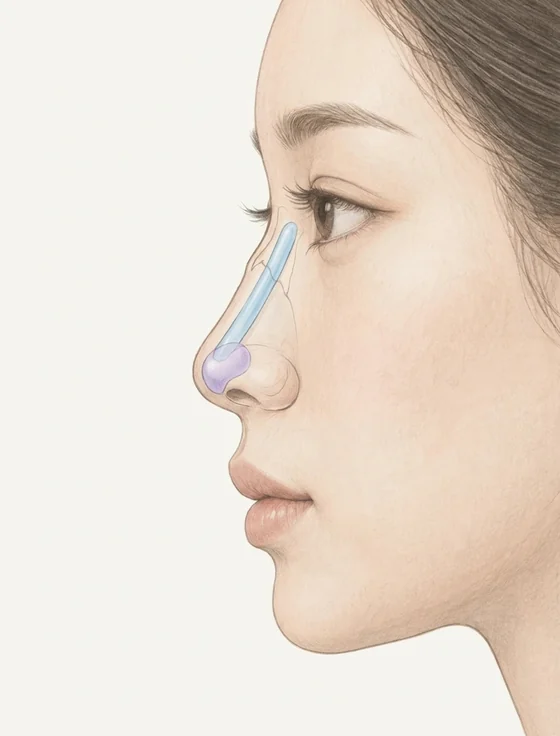
- 3After surgeryFinish by confirming a line that flows naturally from the bridge to the tip and overall facial balance.
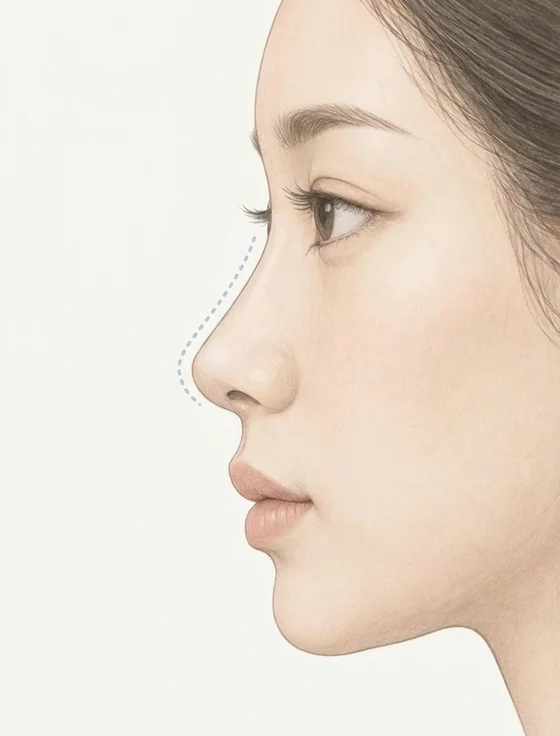
Nasal tip surgery
- 1Check and dissect nasal tip cartilagesCheck the size, shape, and left-right balance of the cartilages that form the nasal tip, and dissect tissues within the necessary range.
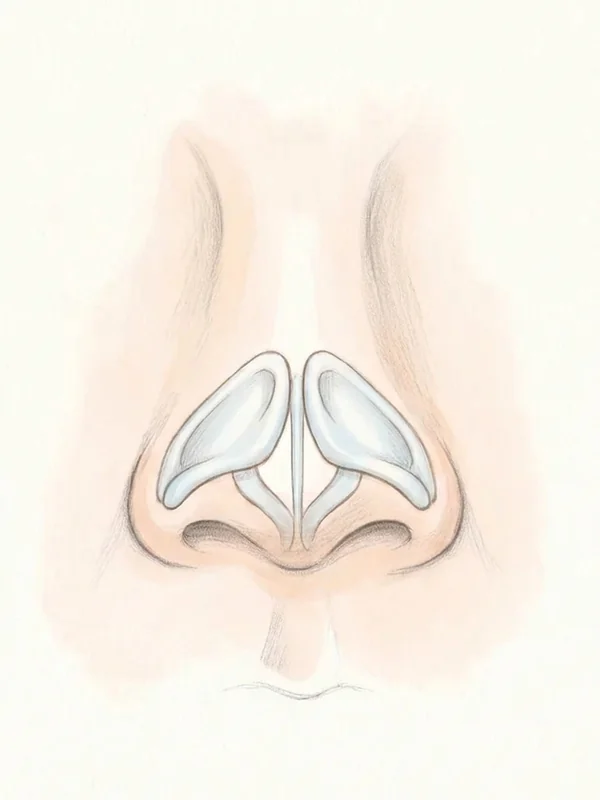
- 2Nasal tip cartilage shaping and supportGather and shape splayed or low tip cartilages, and create a columellar strut using septal cartilage, then insert it between the bilateral lower lateral cartilages. This reinforces the nasal tip support structure and adjusts height and projection.
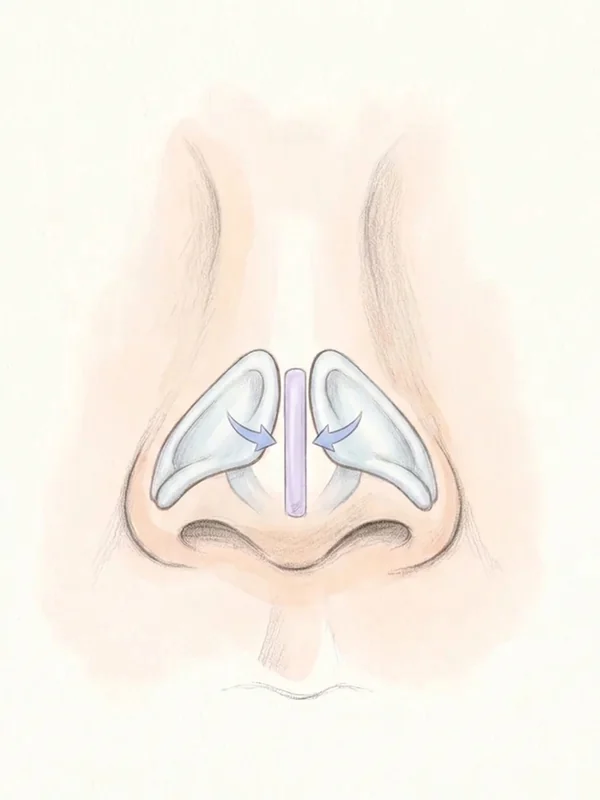
- 3Completion of nasal tip shape using autologous cartilageUsing ear cartilage or septal cartilage Onlay Graft (tip graft cartilage)After crafting it, it is appropriately placed and fixed on top of the nasal tip cartilage. The height, angle, and projection of the tip are finely adjusted, aiming for a natural, three-dimensional tip line.
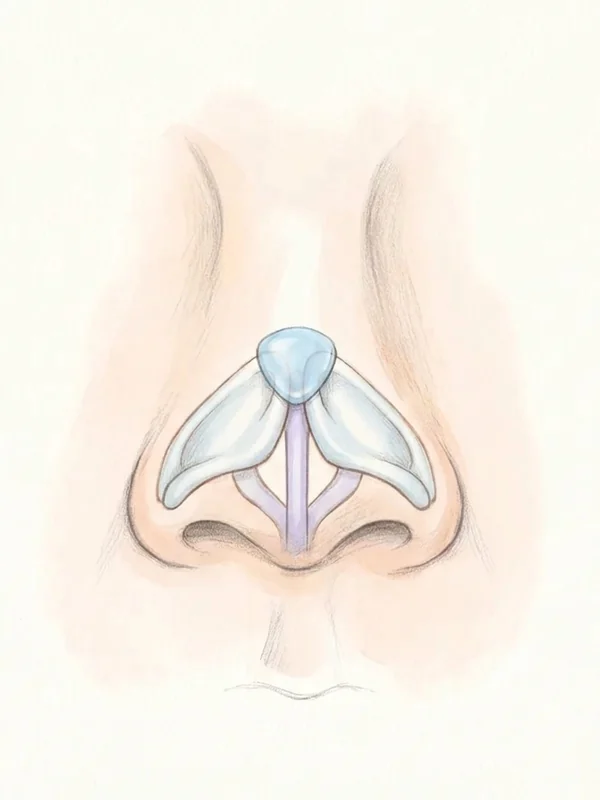
Key points of surgery for a low nasal bridge
Low nasal bridge — KakaoTalk 1:1 consultation
If you are curious about your previous surgical history or your current nose condition, you can inquire via KakaoTalk before consultation.
Low nasal bridge FAQs
If my nasal bridge is low, won’t an implant look too obvious?
Using an implant does not necessarily result in a high, artificial-looking nose. It is important to select an implant of a height and shape that suits the face, taking into account the existing height and width of the nasal bridge, the line from the forehead to the nose, and nasal tip height.
If only the nasal bridge is raised, will the nasal tip look better as well?
The nasal bridge and the nasal tip are connected to each other, but the areas and methods of correction are different. If the nasal bridge is low and the nasal tip is also low or blunt, correcting the nasal tip together, rather than only raising the nasal bridge, may allow the overall nasal line to look natural.
If the nasal tip is also low, is an implant placed in the nasal tip?
In general, for the nasal tip, a method of adjusting height and shape using autologous cartilage rather than an implant such as silicone is considered. The required correction method varies depending on the skin thickness of the nasal tip and the size and support of the existing cartilage.
How is the nasal tip raised?
When nasal tip support is insufficient, a Columellar Strut can be used to support the nasal tip, and an Onlay Graft can be added on top of it to adjust the height and shape of the nasal tip. The amount and position of cartilage needed are determined according to the individual's nasal structure.
Which is better, silicone or Gore-Tex?
No single option is better for everyone. An appropriate material should be selected considering skin thickness, the desired nasal bridge height, the existing shape of the nose, whether there has been previous surgery, and other factors. It is advisable to fully review the characteristics and the advantages and disadvantages of each material before deciding.
Can the nasal bridge be raised using only my own cartilage, without an implant?
Nasal bridge surgery using autologous tissue is also possible, but the tissue and methods that can be used vary depending on the desired height and required volume. In particular, when the entire nasal bridge needs to be raised sufficiently, the surgical method should be decided taking into account the amount of tissue required as well.
My skin is on the thin side—is it okay to raise my nose?
When the skin is thin, the possibility that the implant contour may show through or be palpable must be considered even more carefully. Therefore, rather than raising it excessively, it is important to finely adjust the height and shape of the implant according to the skin thickness and soft-tissue condition.
If the nose is raised, won't it look too high starting from between the eyebrows?
Starting the nasal bridge high from the glabella in every case can give an artificial impression depending on the face. It is important to naturally design the starting position and height of the nasal bridge, taking into account the connection among the forehead, the eyes, the starting point of the nose, and the nasal tip.
If you have surgery for a low nose, will the nose look longer or will the face look different?
If the height of the nasal bridge and the nasal tip changes, the three-dimensional appearance of the face and the overall impression may also change. Rather than simply making the nose high, it is important to create a nasal line that suits the overall proportions, taking into account facial length as well as the forehead, lips, and chin.
Once I have nose surgery, do I never need to replace the implant for life?
An implant that has no problems does not necessarily need to be replaced at regular intervals. However, over time the skin and soft tissue may change, or problems such as implant displacement, showing through, or inflammation may occur, so if any unusual symptoms are present, it is advisable to have the condition checked through a consultation.
Is a higher nasal bridge always more attractive?
Question details: My friends say that if I make it low I will regret it one hundred percent and tell me to make it high.
Not necessarily. If the bridge is made excessively high, the line from the forehead to the nose can look unnatural, or the nose may appear to stick out from the face. Especially when the skin is thin, the implant may show through or its contours may become visible, so it is better to set the height to match skin thickness and facial proportions.
For tip surgery, should I use ear cartilage or rib cartilage?
Question details: Do you always have to use ear cartilage for the tip, or are there cases where rib cartilage is needed? During consultations, one clinic said ear cartilage must be used, while another said rib cartilage is absolutely required, so I don’t know which is correct.
The same cartilage is not used for every patient. Depending on the needed tip height and support, the amount of existing septal cartilage, and any prior surgery, septal cartilage, ear cartilage, or rib cartilage can be selected. Especially in revision cases or when much support is required, rib cartilage may be considered.
I had nose surgery using ear cartilage; is cartilage show-through common?
Question details: I had nose surgery 4 days ago. Because I had surgery for a deviated septum previously, this time it was done using only ear cartilage. After surgery I saw on various communities that cartilage can show through, so I am worried. Is cartilage show-through a common issue, or is it more common that it does not occur?
It can occur if the nasal skin is very thin or if the tip was raised excessively. Depending on the surgical method, the probability varies, but when ear cartilage is used, the likelihood of cartilage showing through is relatively a bit lower. People with very thin nasal skin may have their existing cartilage show through even without surgery; they simply may not have recognized it before surgery. Conversely, those with thick skin and abundant tissue rarely show through even after surgery. If the nose was not raised excessively, you do not need to worry greatly.
In rib cartilage nose surgery, how are autologous rib and donated rib different?
Question details: In consultation, I was told my bridge is so low that rib cartilage is needed. I also wonder which is better.
Autologous costal cartilage uses your own rib cartilage harvested for use, and donated costal cartilage uses a donor’s cartilage that has undergone appropriate processing. Autologous rib has the advantage of being your own tissue, but it requires an additional operation and scar on the chest area. Donated rib does not require a separate harvesting operation, but the possibilities of absorption or deformation should be considered together. Neither one is better for every patient; it is chosen based on the needed support, the surgical goal, and the status of any previous surgery.
Three months after nose surgery, my tip seems to have dropped. Do I need revision surgery?
Question details: I’m wondering if the tip drops again after nose surgery. It has been 3 months since surgery, and the tip seems a bit lower. I asked not to make the tip too high during surgery, and I regret it.
Immediately after surgery, due to swelling and tissue tension, the tip can look slightly higher, and it settles naturally over time. It is hard to say all of this is tip droop. However, if the original tip support is weak or the skin is thick and heavy, surgery should account for long-term changes. At 3 months, swelling and scars have not fully matured, so it is better to continue observation.
One month after nose surgery, the tip feels hard—will it stay this hard?
Question details: My nasal tip is much harder than before surgery and doesn’t move well.
In the early period after surgery, swelling and scar tissue can make the nasal tip feel firm with limited movement. Over time, it often becomes somewhat softer, but depending on the cartilage used and the method of supporting the nasal tip, it may not become exactly as soft as before surgery.
After nose surgery, will I never be able to press the tip to make a “pig nose” again?
Question details: I was told not to do it after surgery.
If cartilage is used to support the nasal tip and it is structurally fixed, movement of the tip may be more limited than before surgery. In particular, it is best to avoid forcefully pushing the tip upward. Over time it may look more natural to some degree, but the degree of movement varies depending on the surgical method.
My bulbous tip is on the severe side; can nose surgery make the tip slim?
Question details: It’s a bulbous tip like a Hallabong.
A bulbous tip is not simply due to a low tip; multiple factors such as the shape and splaying of the tip cartilages and the thickness of the skin and subcutaneous tissue act together. Therefore, in some cases raising the tip alone is sufficient, but in other cases the cartilage shape needs correction or the tip volume should be appropriately reduced. If the skin is very thick, there can be limits to making a very thin and sharp tip with surgery alone.
How do I decide on a nose shape that suits my face?
Question details: I wonder if this is discussed during consultation. I do not want to end up with an “avatar nose.”
The desired nose shape matters, but you should also consider the face’s length and width, the degree of forehead and lip projection, and the existing nose’s height and length. Rather than copying a specific celebrity’s nose, it is important to find a bridge height and tip shape that look natural on your own face.
Depending on the individual, side effects such as bleeding, infection, swelling, asymmetry, and scarring may occur, and the degree may vary. Please make your decision after sufficient consultation with a specialist.
View together by rhinoplasty type
Please review our complete guide to Low Nasal Bridge, Upturned Nose, Arrow Nose, Deviated Nose, Dorsal Hump, Alar Reduction, revision rhinoplasty, and Rhinoplasty.
View rhinoplasty types and revision, with 3D CT analysis, on one page.
NOSE Upturned Nose/Short NoseAn upturned or short nose refers to a shape in which the length of the nose is relatively short or the nasal tip is lifted upward so that the nostrils are highly visible from the front.
NOSE Arrow Nose/Long NoseAn arrow or long nose refers to a shape in which the nasal tip droops downward or the length of the nose appears long relative to the face.
NOSE Deviated NoseA deviated nose refers to a shape in which the nasal bridge or nasal tip bends to one side away from the facial midline, making the nasal line appear asymmetric.
NOSE Dorsal HumpA dorsal hump refers to a shape in which the nasal bone and cartilage forming the nasal dorsum are overly developed or protruding, so that the middle portion of the nasal dorsum appears bulged in profile.
NOSE Alar ReductionAlar reduction is a surgery that adjusts the width and shape of the alar to create a more balanced nose shape when the alar is widely spread to the sides or the nostrils appear large, making the nose look wide and blunt.
NOSE Revision RhinoplastyRevision rhinoplasty is surgery performed when, after a previous rhinoplasty, the shape of the nasal bridge or tip is unnatural or asymmetry has developed, or when further correction is needed due to implant malposition or showing through, nasal tip deformity, contracture, or similar issues.
Low nasal bridge — KakaoTalk 1:1 consultation
If you are curious about your previous surgical history or your current nose condition, you can inquire via KakaoTalk before consultation.