

Senior Cosmetic Surgery
Lift/lifting treatment for sagging in the elderly
Senior Cosmetic Surgery is the collective term for lift/lifting treatments conducted by ImageUp Plastic Surgery Clinic for facial and neck sagging in the elderly. It includes Perfect Bespoke Facelift as well as midface lift, forehead lift, upper blepharoplasty, brow lift, lower blepharoplasty, neck lift, turkey neck deformity, platysma muscle restoration, and reinforcing treatments such as laser lift, HIFU lift, and radiofrequency lift. Senior Cosmetic Surgery is a treatment that reviews both incision-accompanied lift surgery suited to the degree of facial and neck sagging in the elderly and non-incisional laser, HIFU, and radiofrequency reinforcing treatments. Whether a facelift is possible depends not on numerical age but on the actual health condition of the body, and it is confirmed before surgery with ASA physical status classification and checklist.
The specific treatments handled by each Medical Director are confirmed and guided during consultation. The detailed method, anesthesia, required time, and recovery information for this procedure are provided individually through consultation.
What age is Senior Cosmetic Surgery · Silver Cosmetic Surgery?
| Category | Age | Description |
|---|---|---|
| Senior Cosmetic Surgery | Mid-to-late 50s to 60s | A broad term referring to the period when aging accelerates after menopause |
| Silver Cosmetic Surgery | 65 years and older | Elderly welfare law and WHO criteria for elderly age |
| Very elderly | 75 to 80 years and older | Age at which anesthesia and surgical plans are made more carefully |
※ Both terms do not have medically defined definitions and are common classifications.
Physiological age rather than calendar age
- Calendar age
- The number on your resident registration.
- Physiological age
- It is the actual health status of the body. It is evaluated by looking at accompanying diseases, control status, and physical strength, using the ASA classification.
Even at the same age of 70, health conditions vary completely from person to person. Some people hike every day, while others get out of breath after climbing just a few stairs. What is more important than the age on your resident registration, that is, calendar age, is how healthy the body actually is—physiological age.
Just because someone is elderly does not mean they cannot undergo a Facelift. However, as age increases, the evaluation criteria shift from 'how old are you' to 'what diseases are present and how well they are controlled.' That criterion is the ASA classification.
ASA Physical Status Classification and Judgment by Grade
ASA is a physical status classification created by the American Society of Anesthesiologists, which divides the overall condition of a person facing surgery and anesthesia from Grade 1 to Grade 6.
| Grade | Status | Example |
|---|---|---|
| I | Healthy state | No special underlying diseases, non-smoker |
| II | Mild systemic disease | Well-controlled hypertension·diabetes, smoking, obesity (BMI 30~40) |
| III | Severe systemic disease | Poorly controlled hypertension·diabetes, COPD, dialysis, myocardial infarction·stroke 3 months ago |
| IV | Life-threatening disease | Myocardial infarction·stroke·stent within 3 months, severe valvular disease |
| V·VI | Moribund · brain death | Unrelated to cosmetic surgery |
How is Facelift judged by ASA grade?
| Grade | Judgment | Details |
|---|---|---|
| ASA I · II | Suitable | Applies to most seniors · Surgery can be considered if well controlled |
| ASA III | Selectively possible | Internal medicine·cardiology consultation opinion · When condition is stable · Anesthesiologist + inpatient observation environment |
| ASA IV or higher | Postpone · Contraindicated | Cosmetic-purpose surgery is not performed · Recovery of condition is the priority |
※ This is a general standard, and the methods performed at our clinic will be explained during consultation.
8 Preoperative Checklists
From examination to customized surgical planning
It proceeds in the order of medical interview, preoperative testing, ASA classification confirmation, and customized planning. Preoperative tests include blood tests (anemia, coagulation, kidney, liver), and if necessary, glycated hemoglobin, electrocardiogram, and chest X-ray are checked. Once results are available, the ASA grade is finalized and surgery is planned accordingly.
For healthy grade 1-2, both sedation and general anesthesia can be considered. If elderly with multiple factors to consider, generally reduce surgery time, avoid combining multiple surgeries at once and perform them separately, and overnight hospitalization for observation may be recommended. For ASA grade 3, consultation opinion, anesthesiologist involvement, and hospitalization for observation are generally prerequisites, and in some cases, a reduced-scope surgery is reviewed as an alternative.
※ This is a general standard, and the methods performed at our clinic will be explained during consultation.
6 Items to Prepare Before Consultation
- Medication bags · prescriptions, all supplements
- Please bring all your medications and supplements.
- Health checkup · blood test results from the past year
- Health checkup or blood test results received within the past year.
- Medical records for major medical history (stent · stroke)
- If there is a major medical history such as stent or stroke, prepare the medical records from the attending physician.
- Past facial procedure · surgery history
- Please inform us of past facial procedures and surgeries along with when they were performed.
- Smoking status (including e-cigarettes)
- Please honestly inform us of your smoking status.
- Caregiver plan to be with you before and after surgery
- Prepare a caregiver plan to accompany you before and after surgery.
Whether facelift is possible depends not on age but on preparation. In particular, blood pressure, medications, and smoking cessation are the most important management items for reducing common complications.
※ Surgical results are not the same for everyone. Side effects such as bleeding, hematoma, infection, nerve damage, and scarring may occur, and results vary depending on individual health conditions. Therefore, sufficient consultation and examination come first.
Senior cosmetic surgery, what should be considered?
Which areas are treated?
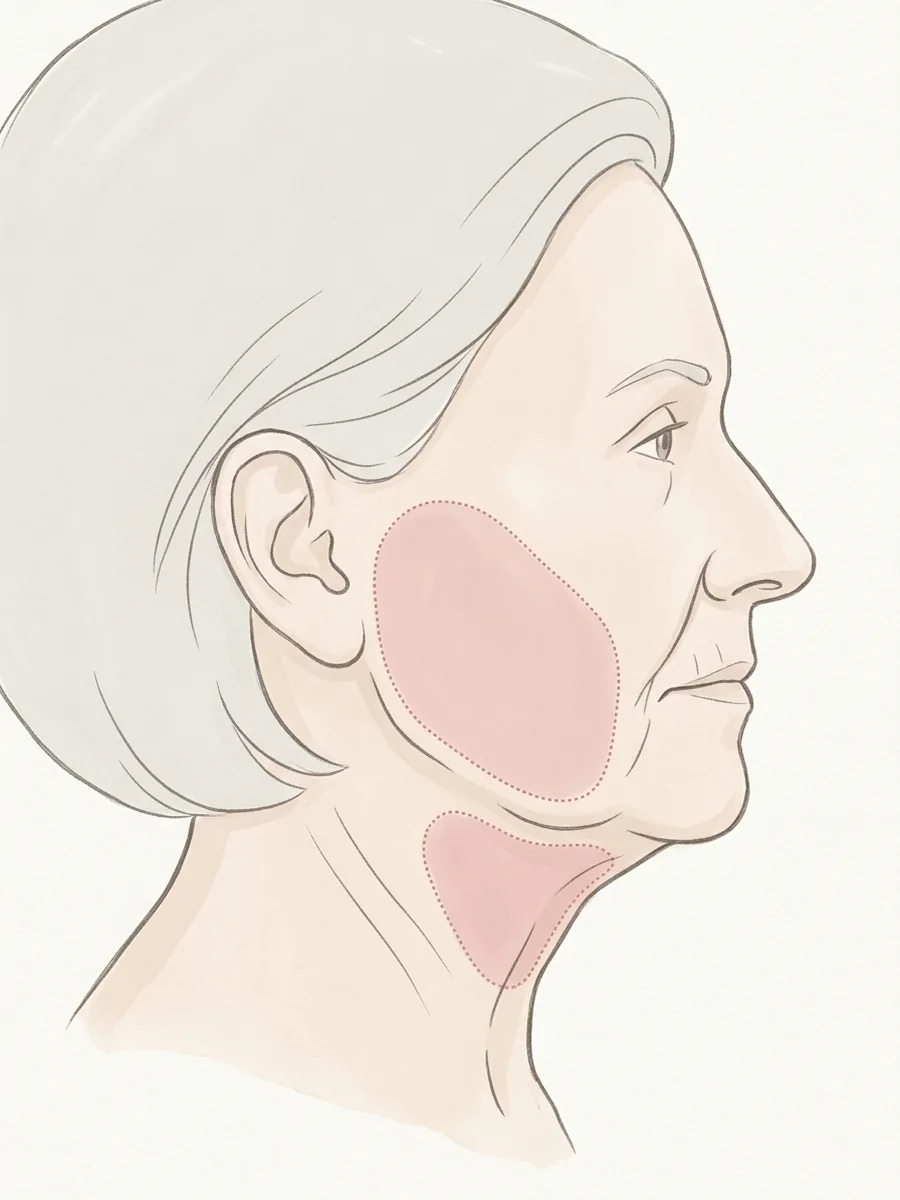
The illustration is for explanatory purposes to aid understanding, and surgical results vary by individual. The actual method is determined individually during consultation.
If you are curious about Senior Cosmetic Surgery — KakaoTalk 1:1 Consultation
The appropriate method varies depending on the degree and extent of sagging, so you can make a preliminary inquiry via KakaoTalk before treatment.
Senior Cosmetic Surgery Frequently Asked Questions
I am in my 70s. Can I undergo a facelift?
Advanced age alone does not preclude a facelift. Feasibility is determined not by chronological age but by the individual's actual health status, specifically the presence and control of any underlying conditions. Even at the same age of 70, health status varies greatly from person to person, so preoperative assessment of overall condition is performed using the ASA physical status classification.
From what age does senior cosmetic surgery or silver cosmetic surgery refer to?
Neither term has a strictly defined medical definition; they are conventional distinctions. Senior cosmetic surgery generally refers to those in their mid-to-late 50s through 60s, while silver cosmetic surgery often refers to those 65 years and older, in line with the Korean Elderly Welfare Act and the World Health Organization's criteria for the elderly. Medical literature separately classifies those aged 75–80 and above as the very elderly, and for this age group, anesthesia and surgical planning are approached with greater care.
What is the ASA physical status classification?
It is a classification system developed by the American Society of Anesthesiologists that categorizes a patient's overall physical condition prior to surgery and anesthesia from Grade 1 to Grade 6. Grade 1 indicates no significant underlying disease, while Grade 2 indicates mild systemic disease such as well-controlled hypertension, diabetes, or smoking. Grade 3 refers to severe systemic disease that limits daily activity, such as poorly controlled diabetes, hypertension, or chronic lung disease, and Grade 4 or higher indicates a life-threatening condition.
If I have underlying diseases, can I not undergo a facelift?
Grades 1 and 2 fall within the range where surgery can be considered; most senior patients correspond to Grade 2, taking medications for hypertension or diabetes. Grade 3 is selectively considered only when internal medicine or cardiology clearance confirms stable condition under general criteria, and Grade 4 or higher prioritizes recovery over cosmetic surgery. The methods performed at our clinic are explained during consultation.
What should my blood pressure be to undergo surgery?
Before surgery, it is confirmed that blood pressure is stably controlled at approximately below 140/90 mmHg, and surgery is postponed if it is 180/110 or higher. High blood pressure, especially a sudden rise immediately after surgery, is the greatest risk factor for hematoma, where blood accumulates under the skin. Blood pressure medications are usually taken until the morning of surgery, but some may need to be paused that day, so please follow the clinic's instructions.
I am taking medication to thin my blood after stent placement. Do I need to stop it?
Do not stop it on your own. Antiplatelet agents such as aspirin or clopidogrel, or anticoagulants such as warfarin, increase bleeding risk, but arbitrarily stopping them in patients with stents or a history of stroke can lead to even more dangerous events. The decision to discontinue and the duration are determined jointly by the prescribing physician and the surgical clinic.
Can I undergo a facelift even if I have diabetes?
Surgery is planned after confirming that HbA1c is controlled to approximately below 8%. This is because poor blood sugar control delays wound healing and increases infection risk. SGLT2 inhibitor-class diabetes medications require discontinuation several days before surgery, so please inform us.
I do not have diabetes, but I am receiving weight management injections. Is that okay?
Even without diabetes, if you are receiving GLP-1 class injections for weight management, please be sure to mention it during consultation. These medications slow gastric emptying and can increase the risk of food entering the lungs during sedation or anesthesia.
I have smoked for a long time. How long do I need to quit?
You must quit smoking for at least 4 weeks both before and after surgery. Because facelift surgery lifts and tightens the skin, blood flow to the skin is critical, and there are consistent reports that smokers have several times higher risk of skin necrosis. Electronic cigarettes, nicotine patches, and gum also constrict blood vessels and are not exceptions.
I have severe snoring. Is it okay to have sedation anesthesia?
Severe snoring or reports of breathing pauses during sleep may indicate sleep apnea, which carries a risk of airway obstruction during sedation anesthesia. Therefore, the anesthesia method and monitoring during anesthesia are adjusted, so please be sure to mention it during consultation.
My heart is on the weaker side. Will I need tests before surgery?
It may be necessary depending on your condition. A simple criterion is whether you can climb two flights of stairs without pausing. If that is difficult, it is advisable to undergo a cardiac evaluation before surgery. In addition, the control status of chronic lung disease or asthma is checked, and kidney and liver function are evaluated to determine medication dosage and bleeding tendency.
If I am older, could I become mentally confused after anesthesia?
In older adults, postoperative delirium, which causes temporary confusion after anesthesia, can occur. If there is memory impairment, medications are selected more carefully, and a guardian must be present at all times. After surgery, vision is limited by bandages and the body is not fully awake, increasing fall risk, so please plan the discharge route and guardian support in advance.
I am taking multiple medications. Is that okay?
If you take five or more medications, the full list is cross-checked. If you are in a 'frail' state with recent weight loss, slowed gait, and easy fatigue, recovery may be slower even at the same grade, so this is also evaluated.
Can a facelift cause blood clots in the legs?
The risk of leg blood clots is relatively low when performing facelift alone. However, the risk increases with prolonged surgery under general anesthesia, combined procedures, or overlapping factors such as advanced age, obesity, or hormone therapy. Therefore, risk is scored, and prevention with leg compression devices and early ambulation is used when necessary.
What tests are performed before surgery?
Anemia, coagulation function, and kidney and liver function are checked with blood tests, and if needed, glycated hemoglobin, electrocardiogram, and chest X-ray tests are performed. Once the results come out, the ASA grade is finalized and surgery is designed accordingly.
Do you use sedation anesthesia or general anesthesia?
For Grades 1 and 2, both sedation anesthesia and general anesthesia can be considered. If there are multiple factors to consider in an older patient, the general approach is to shorten surgical time and stage procedures. The methods performed at our clinic, including whether inpatient observation is needed, are explained during consultation.
What should I bring to a senior facelift consultation?
Please bring all medication bags or prescriptions and nutritional supplements, health check-up and blood test results from the past year, and medical records for major conditions such as stents or stroke if applicable. Please also inform us of any prior facial procedures or surgeries and smoking status (including e-cigarettes), and it is helpful to decide on a guardian who will accompany you before and after surgery in advance.
Depending on the individual, side effects such as bleeding, infection, swelling, asymmetry, and scarring may occur, and the degree may vary. Please make your decision after sufficient consultation with a specialist.
※ Surgical method, recovery period, and results vary individually depending on the degree of sagging, skin condition, tissue condition, etc., and the exact surgical plan is determined after consultation. The possibility of side effects and complications will be explained together during the consultation.
For additional inquiries, contact us via KakaoTalk
1:1 KakaoTalk pre-inquiry — Mon–Thu 10:00 - 19:00 · Fri 10:00 - 21:00 · Sat 10:00 - 16:00.