

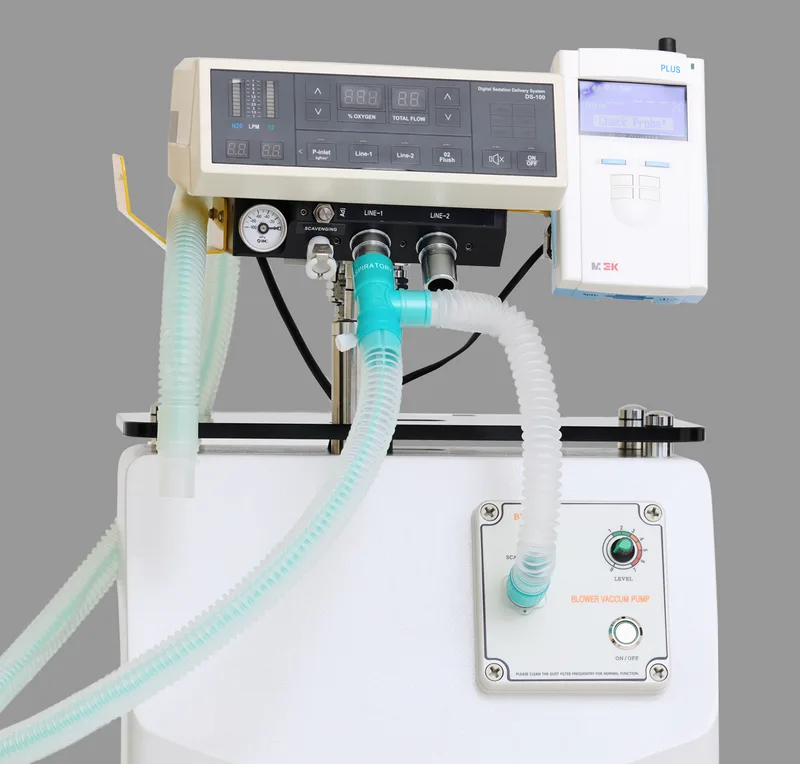
Inhalation Anesthesia Machine (AIRNOX)
The Principle of the Breathing Anesthesia Machine (AIRNOX)
The precise combination of AIRNOX's nitrous oxide (N₂O) and oxygen (O₂) temporarily calms the central nervous system within a safe range, reducing the sensitivity to pain. This dulling of sensation proceeds while the patient remains conscious, and it can be directly controlled by the medical staff and the patient.
All of these processes occur while the patient is in a stable and comfortable state. After the procedure, the sedated sensations return to normal relatively quickly. Most cases do not require a long separate recovery time, but if dizziness or discomfort remains depending on the individual's reaction, it is recommended to confirm sufficient recovery before going home and driving.
At a Glance
AIRNOX is a non-sleep sedation and analgesia system that helps reduce pain and tension during procedures by inhaling a gas mixture of nitrous oxide and oxygen. Consciousness is maintained so conversation with medical staff is possible, and it does not completely replace local anesthesia.
6 Special Points of AIRNOX
- Because the patient controls the intensity of pain while conscious, the procedure can be received comfortably without anxiety.
- The entire process of controlling pain is carried out while the patient maintains memory and consciousness to directly confirm it.
- It helps reduce procedure stress by reducing pain and allowing the procedure to proceed comfortably.
- It helps reduce pain and tension. In many cases, separate fasting is not required, and most do not need a long separate recovery time. However, dizziness, nausea, headache, or a dazed feeling may occur depending on the individual, so it is recommended to confirm sufficient recovery before going home and driving.
- Because sufficient communication between the medical staff and the patient is possible even during the procedure, adjustments to pain intensity and procedure response can be applied quickly in real time.
- It is a system that uses nitrous oxide, precisely controlled for convenient use.
Frequently Asked Questions
What kind of procedure is AIRNOX?
AIRNOX is a non-sleep sedation and analgesia system that reduces pain and tension during procedures by inhaling a gas mixture of nitrous oxide (N₂O) and oxygen (O₂). Unlike sleep anesthesia that puts you to sleep, it helps you undergo the procedure more comfortably while maintaining consciousness.
Does AIRNOX really make the pain disappear?
The pain does not disappear completely. It lowers sensitivity to pain and anxiety to help you feel the actual pain more weakly. There are individual differences in how it is felt, and for procedures with significant pain, it can be used together with local anesthesia.
How is AIRNOX different from sleep anesthesia?
The biggest difference is the presence or absence of consciousness. With AIRNOX, consciousness is maintained even during the procedure, allowing you to talk with the medical staff or respond to requests. After the procedure, the sedative effect disappears relatively quickly, so it does not require a long recovery time like sleep anesthesia.
What does it feel like when you do AIRNOX?
There are individual differences, but you may feel your body relaxing, slightly drowsy, or tension being released. Rather than the pain itself disappearing, in many cases the anxiety and sensitivity to pain decrease, making it feel more comfortable than before.
Can I talk with the doctor while doing AIRNOX?
Yes. Since AIRNOX is not sleep anesthesia that causes loss of consciousness, communication with the medical staff and doctor is possible even during the procedure. It is also an advantage that the procedure can be carried out while checking the patient's reaction and level of discomfort.
If I do AIRNOX, do I not need local anesthesia?
That is not the case. AIRNOX helps reduce pain and tension but does not completely replace local anesthesia. Depending on the type of procedure and the degree of pain, local anesthesia and AIRNOX are sometimes used together.
Do I need to fast to receive AIRNOX?
Unlike general sleep anesthesia, AIRNOX often does not require separate fasting. However, preparation requirements may vary depending on the patient's condition, the procedure being performed together, and the anesthesia method, so it is best to follow the medical staff's guidance before the procedure.
Will I remain drowsy even after the procedure is over?
A characteristic of AIRNOX is that its sedative effect disappears relatively quickly. After the procedure ends, oxygen is supplied and the process of returning to normal state is followed, and in most cases a separate long recovery time is not required. However, if dizziness or discomfort remains depending on individual reaction, it is good to confirm full recovery before going home.
Are there any side effects with AIRNOX?
It is mostly used for a short time and the effect disappears quickly, but depending on the individual, dizziness, nausea, headache, or a drowsy feeling may appear. Also, it is not suitable for all patients, so if there is a past medical history, current health condition, or medications being taken, it is important to inform the medical staff before the procedure.
For which procedures is it good to use AIRNOX?
It can be considered when pain or tension makes the procedure burdensome. It can be utilized in cosmetic procedures that may involve pain such as laser or lifting, and what procedure it is appropriate for is determined by considering the type of procedure, the patient's pain sensitivity, health condition, etc.
Can I drive myself home after AIRNOX?
We advise you to drive only after it has been confirmed that you have fully recovered from the procedure.
Depending on the individual, side effects such as bleeding, infection, swelling, asymmetry, and scarring may occur, and the degree may vary. Please make your decision after sufficient consultation with a specialist.
For additional inquiries, contact us via KakaoTalk
1:1 KakaoTalk pre-inquiry — Mon–Thu 10:00 - 19:00 · Fri 10:00 - 21:00 · Sat 10:00 - 16:00.