

Fat Grafting
We consult for natural volume within the range that can engraft
Fat Grafting is surgery that refines autologous fat harvested from the abdomen, thighs, etc., and injects it into desired areas such as the face or chest. Because not all grafted fat engrafts and some is absorbed, ImageUp Plastic Surgery checks the recipient sites, required amounts, and harvestable fat volume together to make the surgical plan.
At a Glance
Fat Grafting is surgery that harvests autologous fat and injects it into the face, chest, etc., and some of the grafted fat engrafts and some is absorbed. If injected excessively, it may lead to unnatural volume or a higher risk of fat necrosis, so the amount needed for each area is finely adjusted.
Fat Grafting: What will be reviewed during the consultation?
Fat Grafting — KakaoTalk 1:1 Consultation
You can inquire in advance via KakaoTalk about the area you want treated and your volume concerns before the visit.
Where can Fat Grafting be done?
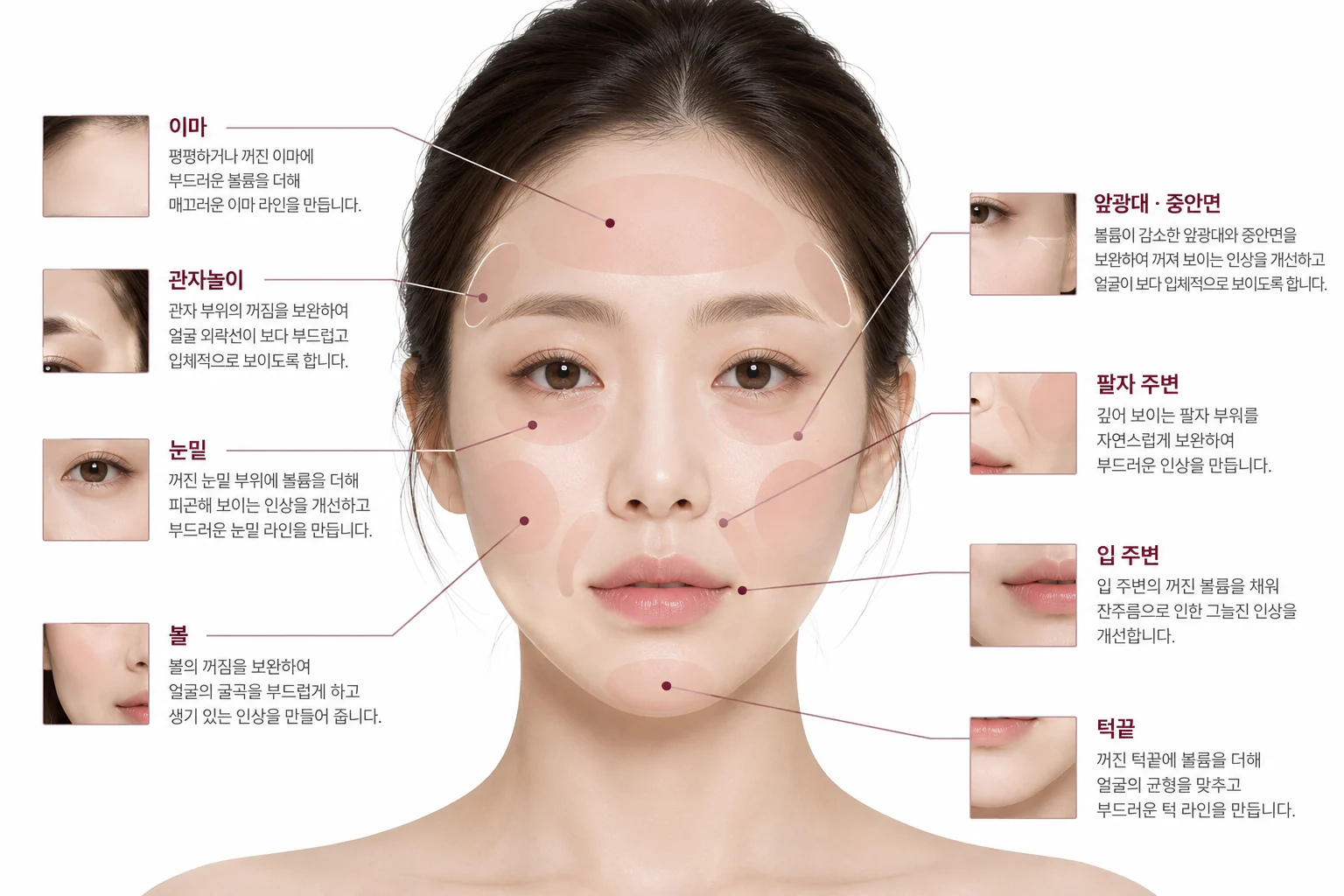
- Forehead
- Adds gentle volume to a flat or hollow forehead.
- Temple
- Addresses hollowness in the temple area to create a softer outer facial contour.
- Front cheekbone · midface
- Supplementing volume in the front cheekbone and midface helps improve a sunken appearance.
- Cheeks
- Fills cheek hollowness and facial irregularities to create a more natural facial line.
- Nasolabial area
- Can address the nasolabial area that appears deeper with midface volume loss.
- Chin · facial contour
- When needed, insufficient volume can be supplemented with the overall facial proportions in mind.
What is the process of Fat Grafting?
Fat Grafting is not simply harvesting fat and putting it into hollow areas.
It involves harvesting only the needed amount of fat, refining fat suitable for grafting, and carefully injecting small amounts across multiple layers in consideration of facial structure and required volume.
-
01
Fat harvest
Only as needed, minimizing burden
Fat is harvested in the required amount from areas suitable for collection, such as the abdomen or thighs. The aim is not excessive liposuction but securing the amount needed for grafting, proceeding with consideration of the donor site's condition and fat volume.
-
02
Fat refinement
Selects fat needed for grafting
Harvested fat contains not only adipocytes but also blood and tissue fluid. Through an appropriate refinement process, unnecessary components are removed and fat for grafting is prepared.
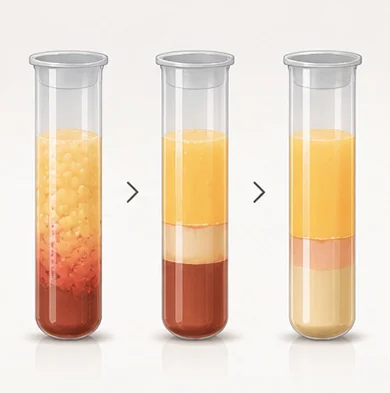
An illustration showing the process of refining harvested fat The illustration is for explanatory purposes to aid understanding, and surgical results vary by individual. The actual method is determined individually during consultation. -
03
Design
We look not only at hollow areas but at the overall facial balance.
Even with the same amount of fat, the impression can differ depending on where and how much is injected. The graft sites and amounts are determined by considering not only the degree of hollowness in each area—forehead, temples, front cheekbone, cheeks, nasolabial area—but also the overall facial contour and left–right balance.
-
04
Micro fat grafting
Rather than placing a lot in one spot, small amounts across multiple layers
Instead of injecting the refined fat all at once into a single area, small amounts are divided and injected into multiple layers of the required areas. The meticulous grafting process is important both to create natural volume and contours and to help the grafted fat settle stably with surrounding tissue.
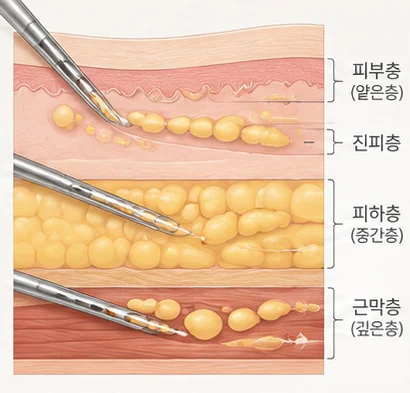
An illustration showing small amounts divided and placed across multiple layers in a skin cross-section The illustration is for explanatory purposes to aid understanding, and surgical results vary by individual. The actual method is determined individually during consultation. -
05
Engraftment and recovery
Not all of the grafted fat remains as is.
Some of the transplanted fat is absorbed during recovery, and the fat that engrafts stably remains. Initially, swelling can make the volume feel large, and over time the swelling subsides and some fat is absorbed, gradually settling into a more natural volume.
Fat grafting—putting in a lot is not what matters
Fat grafting is not a surgery where simply injecting a large amount of fat leads to good results.
If you concentrate an excessive amount into one area, it can create unnatural volume and make stable engraftment difficult. Conversely, if you inject too little, it may be hard to achieve the desired volume.
Therefore, it is important to consider facial structure, skin thickness, existing fat distribution, and the needed volume, and to graft an appropriate amount divided across multiple layers.
‘Engraftment’ determines the outcome of fat grafting
In fat grafting, what matters is not how much you inject but how stably it settles.
Not all of the grafted fat is maintained as is. After grafting, some fat is absorbed, and the fat that receives blood supply from surrounding tissues and settles stably remains. This is called fat engraftment.
The degree of engraftment can vary depending on the recipient area and the condition of the fat, the injection amount and method, and individual recovery. Therefore, it is difficult to predict the exact engraftment rate from the start, and after sufficient recovery, you can check the remaining volume and consider additional grafting if needed.
Rather than forcefully injecting a large amount of fat into one spot, distributing it appropriately across multiple layers is important to reduce the risk of fat necrosis and calcification. In cases where a large volume is grafted, such as the breasts, it is advisable to continue necessary breast screenings even after the procedure.
Fat grafting vs. filler—how are they different?
Both fat grafting and filler are used to replenish deficient volume and improve facial contours, but they differ in material, procedure method, and how they are maintained.
Choose by considering together the required volume and areas, desired duration of effect, and recovery time.
Fat grafting involves harvesting your own fat from areas such as the abdomen or thighs, refining it, and grafting it to the needed areas. It can supplement volume over a relatively broad area at once, and among the grafted fat, the portion that engrafts stably can be maintained long term. On the other hand, it requires harvesting and refining fat, and because some fat is absorbed after grafting, the final remaining amount varies by individual.
Filler involves directly injecting injectables such as hyaluronic acid into the needed areas without separate fat harvesting. It is relatively simple and suitable for finely adjusting small amounts of volume in desired spots, but it is absorbed over time depending on the product, so the duration varies.
When fat grafting may be more suitable
You can consider it when multiple facial areas are generally hollow, or when you want to supplement volume over relatively wide regions together, such as the forehead, temples, anterior cheekbone area, and cheeks.
When filler may be more suitable
You can consider it when you want to refine specific areas such as the nose, chin tip, or lips with relatively small amounts, or when you prefer a simple procedure without fat harvesting.
What’s important is not ‘what you put in’ but ‘where and how much you put in’.
Neither fat grafting nor filler is always the better method.
The suitable method can differ depending on the degree of hollowing and skin condition, the desired change, and the needed volume and areas.
In particular, cases that require naturally restoring overall facial volume and cases that require precisely shaping a specific area need different approaches, so it is important to first assess overall facial proportions and then choose between fat grafting and filler.
Frequently Asked Questions
With fat grafting, does all the injected fat survive?
Question details: I’m also curious how much is lost.
Not all of the grafted fat engrafts. Some engrafts as it receives new blood supply, and some is absorbed. Because engraftment rate varies with the recipient area and the condition of the fat, injection method, and individual tissue condition, it is hard to state uniformly exactly what percentage remains.
Is the very puffy face right after fat grafting the final look?
Question details: I saw someone who had fat grafting, and at first their face looked very puffy. I want a natural result, so I’m wondering if fat grafting always makes you look puffy.
No. Immediately after surgery, not only the volume of the grafted fat but also swelling is present, so you may look much puffier than desired. As swelling subsides and some fat is absorbed, it gradually becomes more natural, so it’s better not to judge the final result by the initial appearance alone.
They say they intentionally inject more at first because some fat will be absorbed—how much more do they put in?
You can account for a certain degree of absorption, but putting in a lot unconditionally is not good. Over-injection can create unnatural volume or irregularities and may increase risks such as fat necrosis. Especially for the face, it is important to finely adjust the amount needed for each area.
Is one fat grafting session enough?
Question details: I’m wondering if a 2nd or 3rd session is necessary.
Some are satisfied with a single surgery, while others receive additional grafting depending on the degree of absorption and the desired volume. It is not a surgery that is predetermined to require multiple sessions from the outset. After sufficient recovery, it is best to decide on additional grafting by assessing the remaining volume and overall balance. Conditions differ by individual—such as the state of the harvested fat and the recipient area—so engraftment rates vary. Therefore, the number of sessions needed also differs from person to person.
If I get fat grafting to the forehead, won’t it become overly bulging and artificial?
Question details: I’m wondering if it will look like a ‘Gangnam beauty’.
If you simply fill the entire forehead a lot, it can look excessively round or protruding. To achieve a natural result, you need to adjust volume with consideration for not only forehead height but also the overall curve connecting the brow ridge, temples, and hairline.
If I have Fat Grafting to hollow anterior cheekbones and lateral cheeks, won’t my face look bigger?
Question details: Recently I lost a lot of weight and my anterior cheekbone and lateral cheek areas have become very hollow. I don’t want filler, so I’m thinking of filling with fat grafting, but I’m worried that adding fat to the anterior cheekbone or cheeks will make my face look bigger.
Fat grafting is not necessarily a surgery that increases overall facial volume. If you properly supplement volume to hollow areas, facial contours can actually look smoother and more refined. Conversely, over-grafting to areas that already have sufficient volume can make the face look wider or heavier.
If I put fat into the nasolabial folds, will the fat be semi-permanent and completely remove the folds?
Nasolabial folds are not caused solely by hollowness under the skin. Multiple factors act together, such as midface sagging, bony structure, and adhesions between the skin and deep tissues. Fat grafting can soften the hollowed portions, but excessively injecting fat in an effort to completely erase deep nasolabial folds may not look natural.
Can fat grafting be done instead of filler for hollowness under the eyes?
Question details: I’m also wondering whether it will become lumpy or uneven.
Because the skin under the eyes is thin, if fat is injected too superficially or too much is placed in one spot, it can look bumpy or like a lump. Since protrusion and hollowness of under-eye fat often coexist, it is important to first check whether simply filling with fat is appropriate.
Is it better to harvest fat from the abdomen or the thighs?
Question details: I have a lot of fat in my arms; if it’s harvested from my arms, will my arms also become slimmer?
It can be harvested from areas with sufficient subcutaneous fat, such as the abdomen or thighs. It is hard to say that fat from a particular area is unconditionally better for everyone. The appropriate site is chosen by considering the amount of fat needed, fat distribution at the harvest site, and body shape. Also, when harvesting from the arms or legs, there is more fibrous tissue along with fat cells, so the survival rate can be lower.
Can slim people also have Fat Grafting?
Question details: What happens if there’s no fat to harvest? I don’t have any belly fat at all.
Even in a slim body type, there is often some fat that can be harvested from the abdomen or thighs, so small-volume facial Fat Grafting may be possible. However, if the harvestable fat is insufficient compared with the required amount, it may be difficult to graft as much as desired.
After facial Fat Grafting, should I avoid massaging the grafted area?
In the early postoperative period, it is best to avoid pressing hard on or repeatedly massaging the grafted area. This is when the newly grafted fat is settling into the surrounding tissue, so unnecessary pressure should be minimized. The timing for starting face washing or massage varies by surgical site, so it is best to follow the guidance provided.
If I diet after Fat Grafting, will the injected fat also go away?
Once engrafted, the fat can be affected by weight changes like normal adipose tissue. If you lose a lot of weight, the volume in the grafted area may decrease; conversely, if you gain weight, the volume may increase. Therefore, it is advisable to keep your weight relatively stable before and after surgery.
I can feel a hard lump where I had Fat Grafting—does that mean the fat has clumped together?
Early on, it can feel firm due to swelling or the healing process. However, if a firm nodule persists over time, it is necessary to check for possibilities such as fat necrosis, calcification, or a cyst. If it enlarges or is accompanied by pain or redness, it is best to be examined.
If I get facial Fat Grafting, could my face become disproportionately large later when I gain weight?
Engrafted fat cells can enlarge when you gain weight. Therefore, if a large amount is grafted and your weight increases significantly, the volume of the grafted area may become larger than expected. It is important not to over-inject, taking long-term weight changes into account.
To add forehead volume, which is better: Fat Grafting or Filler?
Neither method is unconditionally better. Fat Grafting uses your own fat and can supplement volume over a relatively wide area, while Filler has the advantage of allowing relatively small amounts to be adjusted precisely without surgery. It is best to choose by considering the amount and area of volume needed, the desired duration, and the recovery period.
After Fat Grafting, one side of my face looks puffier—was it injected unevenly?
In the early postoperative period, swelling and bruising can appear differently on each side, making one side look larger. Many people also have inherent asymmetry in the facial skeleton or soft tissues. Therefore, rather than concluding early on that the fat was injected differently, it is better to assess overall balance after the swelling has sufficiently subsided.
After facial Fat Grafting, will there be swelling and bruising?
Question details: I’m also wondering when I can return to work.
The degree of swelling and bruising varies by graft amount, area, and individual. Initially, the face may look much more swollen than usual, and bruising may occur. It gradually improves over time, but residual swelling can persist relatively long; if you have important plans, it is best to schedule surgery with sufficient recovery time.
What is fat necrosis that can occur after Fat Grafting?
Question details: I heard fat necrosis is a possible complication—what happens if necrosis occurs?
If the grafted fat does not receive sufficient new blood supply, some of the fat tissue may fail to engraft and undergo necrosis. If the area is small, it may be absorbed without particular problems, but in some cases it can be felt as a firm nodule or cyst-like area. It is important not to force a large amount of fat into one spot and to distribute it appropriately across multiple layers.
I read online that calcifications can develop after Fat Grafting—does this happen to everyone?
Fat that fails to engraft can, through the process of fat necrosis, develop calcification in some areas. In regions like the face, where relatively small volumes are grafted, this often is not a significant issue, but when large volumes are grafted in the breast, imaging tests may reveal calcification or fat necrosis findings. Therefore, after breast Fat Grafting, it is important to continue necessary breast screening.
I want to add quite a lot of volume—if I make my face very full with Fat Grafting, will it sag more as I age?
An appropriate amount of Fat Grafting does not necessarily cause facial sagging. However, if more volume than needed is added, the face can look heavy and puffy, and over time age-related sagging of the skin and soft tissues may appear more pronounced. Especially when sagging already exists, simply adding a lot of volume may not be the best approach.
I think the fat I had injected before is too much—can it be removed?
Question details: I had Fat Grafting before, and it seems too much was injected, so my face looks odd.
If the engrafted fat looks excessive, correction can be considered depending on the condition. However, because facial Fat Grafting is often injected in small amounts across multiple layers, it may be difficult to remove it all easily like general Liposuction. After confirming which areas and layers have excess fat, a correction method should be decided. Usually, rather than direct removal, trying fat-dissolving injections first can naturally reduce the volume.
If I already have Filler in the forehead/nasolabial folds, can I still have Fat Grafting together?
Question details: I’m also wondering whether the Filler needs to be dissolved first.
Having existing Filler does not necessarily mean you cannot have Fat Grafting. However, the surgical plan may change depending on the type of Filler, its location, and how much is present. In particular, if there is already sufficient volume from Filler or the shape is irregular, the Filler may need to be removed or adjusted first before considering Fat Grafting. If the Filler is a hyaluronic acid Filler, it is gradually absorbed, so dissolving it first and then performing Fat Grafting would be advisable.
The harvest sites on my abdomen or thighs are more painful than my face after facial Fat Grafting—is that normal?
Fat Grafting includes not only grafting but also the process of harvesting fat. Therefore, some people feel more bruising, soreness, or muscle ache–like pain at the harvest sites such as the abdomen or thighs than in the face. It often improves over time, but if the pain suddenly worsens or there is severe swelling or redness, it needs to be checked.
After Fat Grafting, when can I start makeup and exercise?
Question details: I need to return to work after surgery, and I’m receiving PT at a health club.
Light daily activities are relatively possible early on, but it is best to avoid pressing the grafted area strongly or giving it impact in the initial period. Makeup is possible after the injection site wounds have stabilized, and strenuous exercise can increase swelling and bruising, so it is better to start gradually depending on recovery status. The exact timing should follow the clinic’s guidance according to the scope of the procedure.
I don’t want a Breast Implant and am considering breast Fat Grafting or Filler. With breast Fat Grafting alone, can I enlarge the breasts as much as with an implant?
Breast Fat Grafting uses your own fat to create a relatively natural volume, but there is a limit to how much fat can be placed in a single surgery. If too much fat is injected at once, the engraftment rate decreases and the likelihood of fat necrosis or cysts may increase. Therefore, if you want a large increase in size, it may be difficult to achieve the desired result with Fat Grafting alone, and if necessary, multiple grafting sessions or other methods can be considered together.
Depending on the individual, side effects such as bleeding, infection, swelling, asymmetry, and scarring may occur, and the degree may vary. Please make your decision after sufficient consultation with a specialist.
Fat Grafting — KakaoTalk 1:1 Consultation
You can inquire in advance via KakaoTalk about the area you want treated and your volume concerns before the visit.