

Body Contouring/Liposuction
We assess fat amount and skin elasticity together during consultation
Liposuction is a procedure that removes subcutaneous fat accumulated in specific areas to improve body shape and lines. At ImageUp Plastic Surgery, we check fat distribution with InBody comprehensive assessment, ultrasound, and body-shape analysis, then make area-specific plans for the face, upper arms, abdomen, thighs, and more. Director Kwak Yeojin handles Liposuction along with Filler and lifting.
At a Glance
Liposuction is not for weight loss but a procedure that reduces subcutaneous fat in specific areas to improve body shape and lines. Preoperative InBody comprehensive assessment, ultrasound, and body-shape analysis are performed; it proceeds under sedation or local anesthesia, and you go home the same day without admission.
Liposuction: what do we check in consultation?
Body Contouring/Liposuction — KakaoTalk 1:1 consultation
You can inquire in advance via KakaoTalk about desired areas and body-shape concerns before your visit.
How is liposuction carried out?
Liposuction is not simply surgery that removes a lot of fat; it is surgery that refines the body contour by considering the thickness and distribution of subcutaneous fat, skin elasticity, and the shape of muscles and bones together.
Before surgery, the distribution of fat and the degree of skin sagging are checked in a standing position and the design is made; a thin cannula is then inserted through a small incision to remove subcutaneous fat.
-
01
Body analysis and design
The distribution of fat, skin elasticity, and left-right asymmetry are checked, and the surgical area is designed.
-
02
Small incision and solution injection
A small incision is made in an inconspicuous location, and a solution for liposuction is injected.
-
03
Liposuction
Using a cannula, subcutaneous fat is removed from the necessary areas while adjusting the overall thickness and contour.
-
04
Line Check and Finishing
Left-right balance and the connection with surrounding areas are checked, and the result is finished to create a natural body line.
Liposuction: which areas can it be done on?
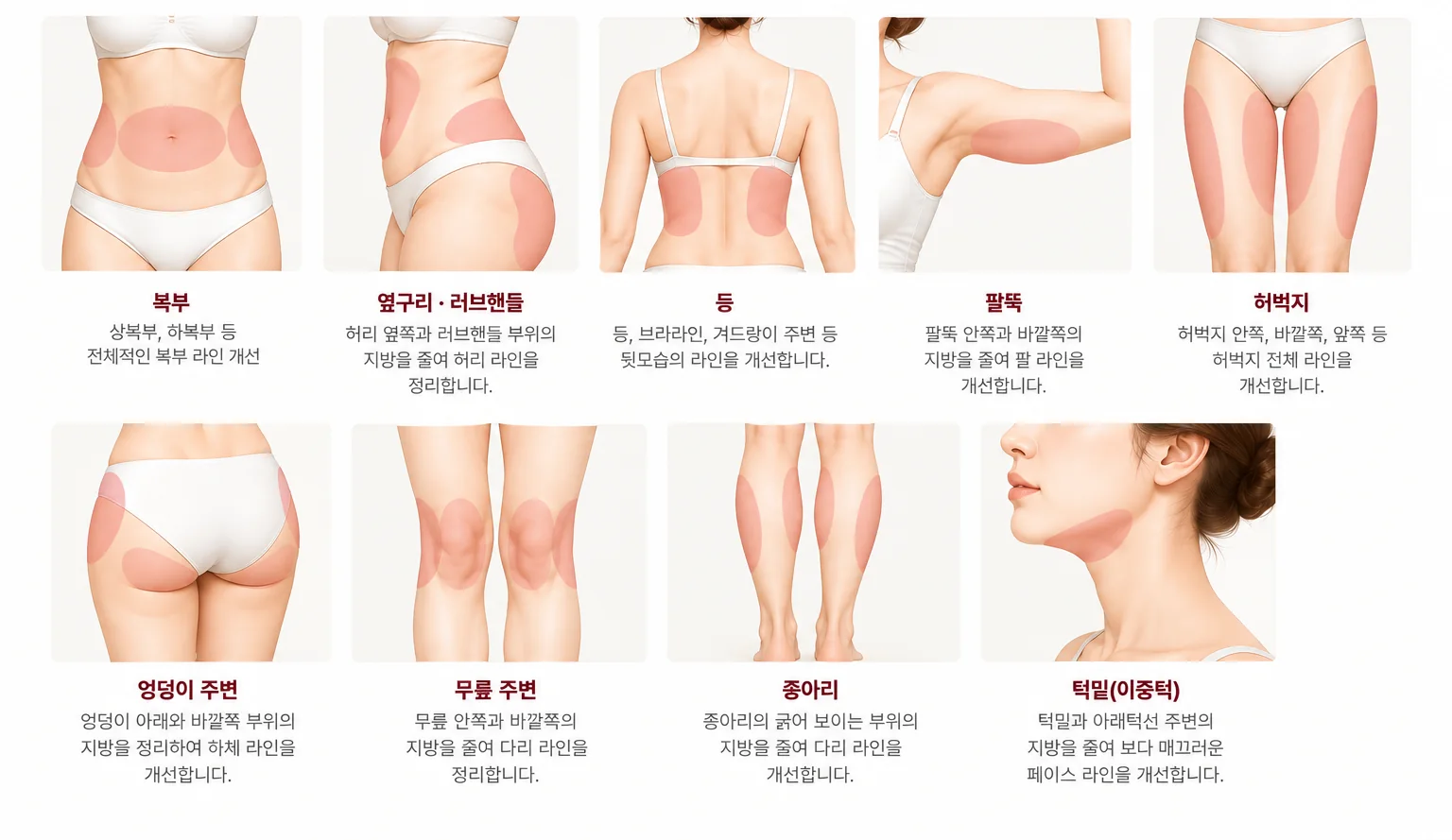
Liposuction can be considered for areas where fat has accumulated locally and makes the body line look thick.
Abdomen · flanks · love handles · upper arms · back · thighs · around the buttocks · around the knees · calves · under the chin, etc.
Even when the same amount of fat is removed, skin thickness, elasticity, and the structure of the fat layer differ by area, so it is important to adjust the extent and amount of suction to the characteristics of each area.
To which layer is fat removed?
Liposuction reduces subcutaneous fat while leaving an appropriate thickness beneath the skin, removing fat evenly from multiple layers, including the superficial and deep layers, to create a natural contour. The range of layers and the amount removed may vary depending on the area and each person's condition.
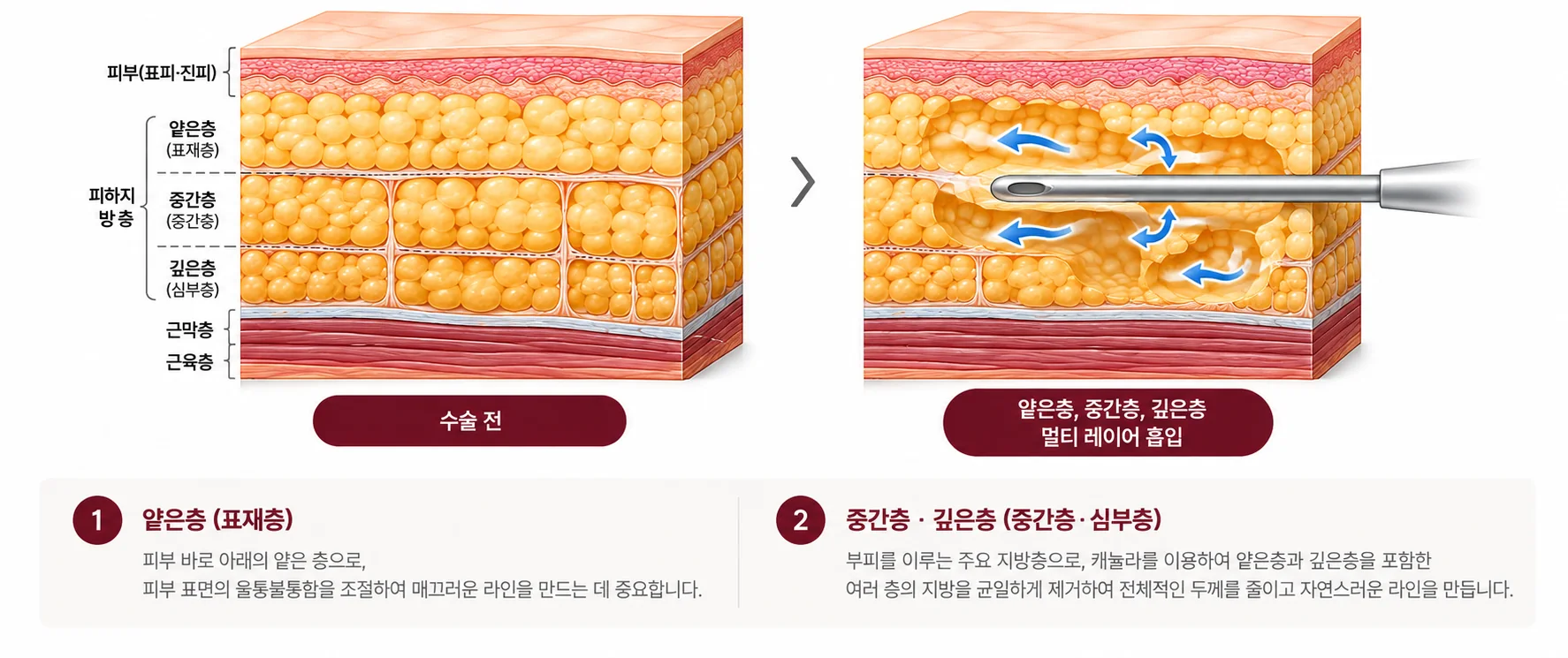
Removing fat in balance matters more than removing a lot
The goal of liposuction is not to greatly reduce body weight but to improve body proportions and contours by reducing fat accumulated in specific areas.
Removing too much fat can make the skin bumpy or cause adhesions, depressions, or skin sagging. Therefore, rather than simply removing as much fat as possible, it is important to consider skin elasticity and the thickness of the fat layer, leaving the necessary fat while making the overall contour even.
We also consider skin elasticity after liposuction
How much the skin contracts after liposuction depends on age, skin elasticity, the amount of fat, the extent of suction, and the degree of existing skin sagging. When skin elasticity is good, the skin can contract to some extent after the fat decreases and adapt to the new body shape, but when there is a lot of skin sagging or a large amount of fat needs to be removed, it may be difficult to achieve the desired contour with liposuction alone.
At ImageUp Plastic Surgery, we evaluate not only the amount of fat but also the elasticity and sagging of the remaining skin, and consider liposuction alone or, when needed, combined with other body contouring methods.
How should I care for myself after liposuction?
After liposuction, it is important to manage swelling and bruising and to help the skin and tissue in the treated area settle steadily into the new body shape. In the early period, the treated area may feel swollen or firm, and these changes ease gradually over the course of recovery.
After surgery, you may wear a compression garment as directed by the medical team to help manage swelling and maintain your shape. Avoid strenuous exercise and start with light walking, then increase daily activity and exercise step by step according to how your recovery is going.
When skin elasticity is good, the skin can contract to some extent after the fat is reduced and adapt to the new body shape, but the speed of recovery and the degree of skin contraction vary from person to person depending on skin elasticity, the amount of fat removed, and the treated area.
Rather than judging the final contour by how you look right after surgery, it is important to give the swelling time to subside and the tissue time to settle.
Frequently Asked Questions
With Liposuction, do size and body weight also decrease a lot?
Liposuction is not so much a surgery to reduce a lot of weight as it is a procedure to remove subcutaneous fat accumulated in specific areas to improve body shape and lines. Weight may decrease by the amount of fat removed, but changes in the contours of the waist, abdomen, thighs, and arms are more important than weight change.
Can the abdomen become completely flat with Liposuction?
Question details: I have a lot of belly fat, and I’m wondering if the abs can be visible.
If the cause of a protruding abdomen is subcutaneous fat, significant improvement can be expected with Liposuction. However, if there is a lot of visceral fat, the abdominal wall is lax, or skin sagging is severe, it may be difficult to make the abdomen completely flat with Liposuction alone.
During Liposuction, how much fat can be removed?
Question details: I’m wondering why we can’t remove it all or whether removing more is better. I want to remove as much as possible.
Removing a lot of fat does not necessarily create a more attractive body shape. Excessive removal can make the skin uneven, cause hollows, or create left-right asymmetry. It is important to remove it evenly while leaving an appropriate thickness, considering not only the amount of fat but also skin thickness and elasticity and muscle shape.
Will fat come back in the area where Liposuction was done?
Question details: I’m wondering whether fat grows again if I gain weight after suction.
It is not typical for the fat cells removed by Liposuction to regenerate as they were. However, the remaining fat cells can enlarge if body weight increases, so weight management after surgery is important.
Is it true that fat shifts to other areas after Liposuction?
Liposuction does not make fat automatically move to other areas. However, if you gain weight after surgery, fat cells in areas that were not liposuctioned can also enlarge, so you may feel that other areas look relatively fatter.
Is Liposuction very painful?
Question details: I’ve heard it’s very painful, so I’m worried. I’m also wondering if I can walk home after surgery.
After surgery, you may feel an ache like after intense exercise or pain as if pressing on bruised areas. It varies with the extent of surgery, but in most cases light walking is possible. In fact, gentle movement within a non-strenuous range can help during recovery.
When does swelling decrease the most after liposuction?
Question details: When I saw my friend, it looked even bigger in the beginning.
Swelling begins immediately after surgery and may feel worse for the first few days. Major swelling then gradually decreases, but residual swelling and firmness can remain for quite some time, so it is difficult to judge results by the body shape immediately after surgery.
It is 2 weeks after surgery, but it looks thicker than before—does that mean less fat was removed?
Question details: It has been 2 weeks since surgery, but it actually looks thicker than before surgery, and not just thicker-looking—it seems I’ve become fatter.
In the early postoperative period, the area may look thicker than before due to swelling, or body weight may temporarily increase. As swelling subsides, the line gradually appears, so it is better not to conclude too early that insufficient fat was removed.
One month after liposuction, my skin is bumpy and hard—is that okay?
Question details: It feels very tight and hard. I’m wondering if it will stay like this for life.
During the recovery of swelling and tissues after surgery, the area under the skin may feel firm or temporarily feel bumpy. It often softens over time, but if severe depressions or irregularities persist, it is advisable to have the operating clinic check the condition.
Does the skin become loose or sag after liposuction?
Question details: I’m worried that if the fat disappears, the skin will look droopy.
If skin elasticity is good, the skin contracts to some extent after fat reduction and adapts to the new body shape. However, if the skin is very lax or elastic recoil is reduced, or if a large amount of fat is removed, residual skin sagging may remain. In such cases, liposuction alone may be difficult to resolve the issue.
They say to wear compression garments after surgery; is it better the longer you wear them?
Compression garments can help with swelling control and the recovery process after surgery. However, overly strong compression or ill-fitting garments can press the skin or cause discomfort. The duration and hours of wear should follow the clinic’s guidance according to the surgical site and extent.
Do I have to get radiofrequency care after liposuction?
Question details: The clinic recommended radiofrequency care; I’m also wondering if more is better.
Not every patient must receive it. Appropriate care may be used to reduce swelling or firmness during recovery, but strong massage or pressure too early may not be good. It is better to start after checking the recovery status of the surgical area. Usually it begins around one month after surgery.
Can I exercise after liposuction?
Question details: I’m worried that if I can’t exercise, I’ll gain the weight back.
Light walking can start relatively early, but exercises that burden the surgical area, such as running or weight training, are best started gradually while monitoring recovery. If a wide area was operated on, more time may be needed for recovery.
It’s one week after liposuction and only my right thigh looks thicker—does that mean it’s uneven?
After surgery, swelling can appear differently on both sides, so the left–right difference may look larger initially. Asymmetry in the original skeleton, muscles, and fat distribution also affects it. It is best to evaluate the final left–right balance after swelling has sufficiently subsided and the tissues have stabilized.
When can I properly know the results after liposuction?
Question details: It has been one month since abdominal liposuction, and I feel it hasn’t reduced well, which is causing a lot of stress. I’m wondering if less fat was removed.
Around one month, major initial swelling may be much reduced, but it is often too early to judge the final result. Residual swelling and subcutaneous firmness gradually improve, and as the skin adapts to the new body shape, the lines can become natural over several months.
If I get arm liposuction, can my arms become markedly thinner?
Question details: I want to wear sleeveless clothing in summer.
If arm thickness is mainly due to subcutaneous fat, you can expect relatively noticeable changes with liposuction. However, if the muscles are developed or the skin is very lax, simply removing fat may not make the arms as slim as desired. In particular, for the arms, creating a line that naturally continues from the shoulder to the elbow is more important than simply reducing the circumference.
If I have Liposuction on the thighs, can the inner thighs be made so they do not touch each other?
If there is a lot of inner thigh fat, a gap may form after Liposuction. However, the gap between the thighs is affected not only by the amount of fat but also by the width of the pelvis, the structure of the leg bones, and the degree of muscle development. Therefore, not everyone will have the thighs completely separate with Liposuction alone.
Is it enough to have Liposuction only on the abdomen?
Question details: I wonder whether the flanks and love handles should be done together as well. I heard there is overall suction and also partial suction.
There are cases where only the abdomen has a lot of fat, but in reality the fat of the flanks and the back of the waist has often developed together. In such cases, if only the front abdomen is reduced, the boundary with the flanks may actually look more prominent. It is advisable to check not only the front view but also the side and back views to decide how far to operate.
I have a lot of lumpy cellulite on my calves. Will Liposuction also get rid of the cellulite?
Liposuction is a surgery that improves the amount of subcutaneous fat and body contour; it is not a surgery that treats cellulite itself. Some improvement may be seen as the amount of fat decreases, but it is difficult to expect the cellulite on the skin surface to disappear completely. In some cases, skin irregularity may become more noticeable.
Will Liposuction leave a lot of scars?
Question details: I wonder where the holes are made. I want to have the entire abdomen done but I am worried that scars will show.
Because Liposuction is performed through a small incision that a cannula can enter, a long surgical scar does not form. Incisions are made considering locations that can be hidden by wrinkles or underwear as much as possible, but in the early period there may be redness or pigmentation. They often fade over time, but a small scar may remain depending on skin characteristics.
Can the suctioned fat also be put directly into the breasts or buttocks?
Question details: I want to put fat suctioned from the abdomen into the buttocks.
A method of appropriately processing fat in good condition among the suctioned fat and grafting it to other areas such as the breasts or buttocks may be considered. However, not all of the suctioned fat can be used, and not all of the grafted fat takes. Desired volume, skin condition, and the amount of fat that can be harvested must be considered together.
Can I have Liposuction one more time?
Question details: I had Liposuction before, but it doesn't seem like enough came off. I'm wondering whether you cannot remove much the second time.
There are also cases where revision surgery is possible. However, in areas that have already undergone Liposuction, adhesions and scar tissue form under the skin, so the fat layer may be irregular and surgery may be more difficult than the first procedure. You should first confirm whether it is simply remaining fat or whether it looks that way because of skin sagging or adhesions, and then decide whether to have revision surgery.
After Liposuction it looks sunken and unattractive. Was too much fat removed?
In the early period after surgery, swelling and adhesions may be uneven, so temporarily sunken-looking areas can appear, making it difficult to immediately judge it as excessive fat removal. If indentations remain clearly even after sufficient recovery, irregularity of the fat layer or adhesions should be checked, and depending on the condition, additional correction methods can be considered.
Which is better to do first, Liposuction or dieting?
Question details: I'm curious whether you slim down more nicely if you also diet after Liposuction, or whether you should diet first and then have Liposuction.
Appropriate weight management helps maintain the body shape created after Liposuction. However, excessively restricting meals or doing excessive exercise right after surgery does not help recovery. It is better to recover while taking in sufficient nutrition in the early period, and then manage weight through appropriate diet and exercise afterward.
Depending on the individual, side effects such as bleeding, infection, swelling, asymmetry, and scarring may occur, and the degree may vary. Please make your decision after sufficient consultation with a specialist.
Body Contouring/Liposuction — KakaoTalk 1:1 consultation
You can inquire in advance via KakaoTalk about desired areas and body-shape concerns before your visit.