

Midface Lift
Sagging cheeks (midface area) local lift to correct
Midface Lift is one of the localized area lift procedures performed at ImageUp Plastic Surgery Clinic and is a treatment that corrects sagging in the facial area. The approach method differs depending on the degree of sagging and the desired range of improvement, so we provide guidance after direct confirmation during consultation.
At a Glance
Midface Lift is one of the localized facial lifting procedures and is a treatment targeting sagging of the cheeks (midface area). An appropriate correction range requires individual evaluation through consultation. Guidance is based on a surgery time of 1 hour under sedation anesthesia. The incision is placed under the eye.
What is a Midface Lift?
A Midface Lift is a surgery that moves upward and fixes the soft tissue around the under-eye area and the anterior malar area that has sagged downward with age.
Principle of Midface Lift
A surgery that repositions the midface skin, subcutaneous tissue, and muscle layer that have sagged downward with age back upward, refining the line from the under-eye area through the anterior malar area to the cheek more naturally and smoothly.
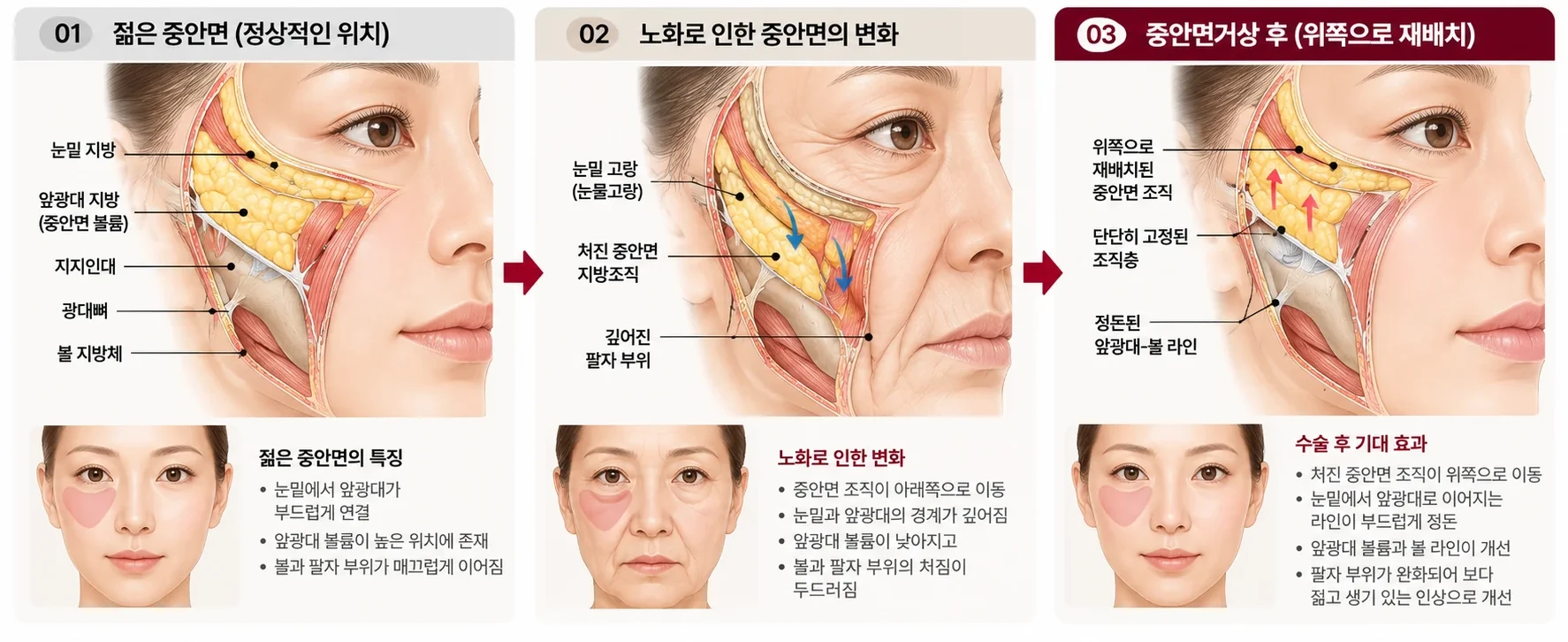
The volume of the midface is not determined by the amount of fat alone but is affected by the position of the skin, subcutaneous fat, muscles, and the tissue that supports them. When this tissue moves downward, the boundary between the under-eye area and the anterior malar area deepens, and as the cheeks sag downward, the nasolabial area may become more noticeable.
Rather than simply removing the sagging tissue, a Midface Lift aims to reposition it upward close to its original position and tidy the line from the under-eye area through the anterior malar area to the cheek more naturally.
How does it change when the midface sags?
In a young face, the under-eye area and the anterior malar area connect relatively smoothly, and the volume of the cheek is formed at a high position.
As aging progresses and the soft tissue of the midface moves downward, the boundary between the under-eye area and the anterior malar area deepens, the volume of the anterior malar area lowers, and sagging of the cheeks and nasolabial area may become noticeable.
A Midface Lift improves the balance of the central part of the face by adjusting the position of the sagging tissue that causes these changes.
How is a Midface Lift performed?
Midface Lift surgical process
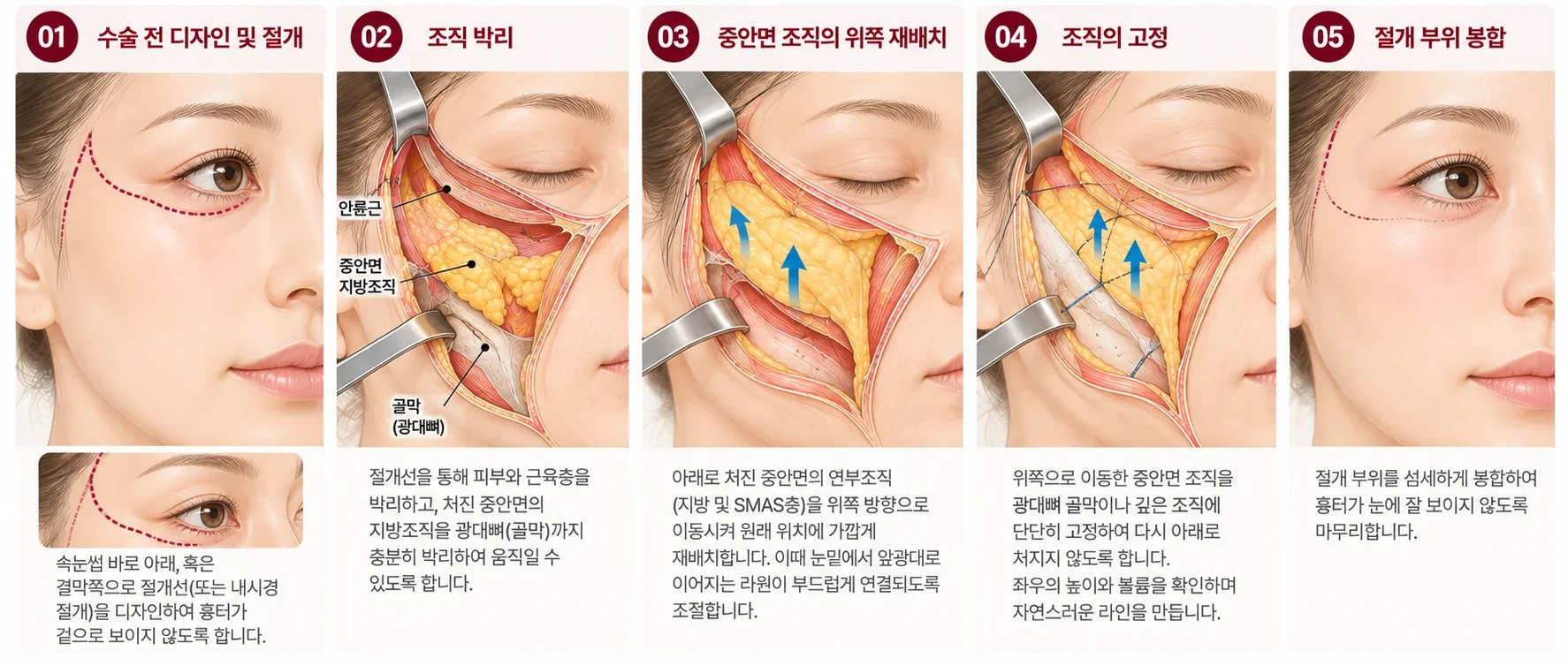
The surgical method may differ depending on each person's anatomy and degree of sagging, and the figure above is an example to help in understanding the general surgical process.
- 01
The sagging of the midface is analyzed
The boundary between the under-eye area and the anterior malar area, the position of the volume, the depth of the nasolabial area, and left-right balance are checked to decide the range and direction in which lifting is needed.
- 02
The sagging tissue is dissected thoroughly
According to the surgical plan, tissue is dissected over the necessary range so that the midface tissue that has moved downward can be moved without strain.
- 03
The midface tissue is repositioned upward
The sagging soft tissue around the anterior malar area and the cheek is moved in an appropriate direction to tidy the line from the under-eye area to the anterior malar area.
- 04
The repositioned tissue is fixed
The moved tissue is fixed securely, and left-right height and the balance of the whole face are checked.
- 05
We close the incision
After the tension of the tissue is adjusted, the incision site is sutured and the recovery process is checked.
It is not a surgery that simply pulls the skin
Sagging of the midface does not occur just because the skin stretches; it is a change that appears as the fat beneath the skin and the structures supporting the soft tissue move downward together.
Therefore, rather than pulling the skin strongly, it is important to let the sagging tissue move sufficiently and then reposition it to an appropriate place.
The direction and degree of lifting are decided by considering the shape of the under-eye area and the anterior malar area, the position of the volume, and the proportions of the whole face.
How is it different from lower blepharoplasty?
Lower blepharoplasty is mainly a surgery that improves aging changes in the lower eyelid area, such as loose skin right below the eye, bulging fat, and tear troughs.
In contrast, a Midface Lift focuses on repositioning upward the sagging tissue of the anterior malar area and cheek, which lie below that.
When under-eye aging and midface sagging appear together, lower blepharoplasty and a Midface Lift can be considered together, depending on the condition of the face.
How is it different from a general Facelift?
A general Facelift mainly focuses on improving sagging of the lower face, extending to the cheeks, jawline and neck.
A Midface Lift repositions sagging tissue mainly in the area above that, from the under-eye area through the anterior malar area to the center of the cheek.
Because aging does not appear in only one area, it is important to check the degree of sagging in the midface and the lower face separately and decide the necessary extent of surgery.
What changes can be expected after a Midface Lift?
As the sagging midface tissue moves upward, an effect of adjusting the lowered position of the volume of the anterior malar area and smoothing the boundary from the under-eye area to the anterior malar area can be expected.
The nasolabial area may look softened as the position of the midface tissue changes, but nasolabial folds are formed by many causes such as skin, fat, muscle movement, and the skeleton, so they do not disappear completely with a Midface Lift alone.
Rather than pulling the face excessively to create a different impression, it is important to naturally restore the position of the sagging tissue while keeping the original structure and expressions of the face.
How is recovery after a Midface Lift?
After surgery, swelling, bruising, and a pulling sensation may appear around the under-eye area, the anterior malar area, and the cheeks. In the early period the degree of swelling on the left and right may look different, and it gradually changes as the tissue stabilizes.
During the recovery period, actions that put strong pressure on the surgical site are avoided, and the wound and swelling are managed as guided by the medical staff.
It is better to evaluate the final facial line after the swelling has decreased and the repositioned tissue has gone through enough of the stabilizing process, rather than right after surgery.
Midface Lift, what should be considered?
If you are curious about Midface Lift — KakaoTalk 1:1 consultation
The appropriate method varies depending on the degree and extent of sagging, so you can make a preliminary inquiry via KakaoTalk before treatment.
Midface Lift Frequently Asked Questions
Why do the cheeks (midface) sag?
As one ages, subcutaneous fat decreases and moves downward, and the supporting ligaments that hold facial tissues to the bone also weaken. When these changes overlap, the cheeks appear hollowed or sagging downward and the nasolabial area looks deeper.
I have sagging cheeks, but would a mini facelift work?
Mini facelift is a method that mainly corrects the lower face, so its effect is limited for nasolabial or midface sagging in front of the cheekbones. After diagnosing which area and which layer the sagging occurred in, we determine the appropriate method.
Can a lift also improve hollow-looking cheeks?
Lift is surgery that restores the position of sagging tissue, and reduced volume is handled separately. If the cheeks or temples appear hollow, we also consider fat grafting to fill the volume.
What kind of surgery is a Midface Lift?
It is a surgery that moves upward and fixes the soft tissue around the under-eye area and the anterior malar area that has sagged downward with age. Rather than removing the sagging tissue, it aims to reposition it close to its original place and naturally refine the line running from the under-eye area to the anterior malar area and the cheeks.
Does a Midface Lift only pull the skin?
No. Midface sagging occurs not only because the skin stretches, but because the structures supporting the fat and soft tissue beneath the skin move downward together. That is why, rather than pulling the skin tightly, it is important to free the sagging tissue enough to move and then reposition it to an appropriate place.
In what order is a Midface Lift performed?
It proceeds in five steps. First, we check the boundary between the under-eye area and the anterior malar area, the position of volume, the depth of the nasolabial area, and left-right balance to decide the extent and direction of the lift. Next, we dissect the necessary range so that the sagging tissue can move without strain, reposition the midface tissue upward and fix it, and then check the left-right height and the balance of the whole face. Finally, we adjust the tension of the tissue and close the incision. The actual method may vary depending on each person's anatomical structure and degree of sagging.
What about anesthesia, surgery time, and the incision site?
We explain it based on a surgery time of 1 hour under sedation. The incision is made below the eye. The exact surgical plan is decided after the consultation.
How is it different from lower blepharoplasty, and can the two be done together?
Lower blepharoplasty is a surgery that improves aging changes in the lower eyelid area, such as loose skin right below the eye, bulging fat, and tear troughs. A Midface Lift focuses on repositioning the sagging tissue of the anterior malar area and cheeks, located lower than that, upward. When under-eye aging and midface sagging appear together, the two surgeries can be considered together depending on the condition of the face.
How is a Midface Lift different from a general Facelift?
A general Facelift focuses on improving sagging of the lower face that runs through the cheeks, jawline, and neck. A Midface Lift repositions sagging tissue centered on the area above that, the under-eye–anterior malar–central cheek region. We check the degree of sagging in the midface and lower face separately to decide the necessary surgical range.
Will a Midface Lift get rid of nasolabial folds?
As the position of the sagging cheek tissue changes, nasolabial folds may look fainter. However, nasolabial folds are formed by many causes such as skin, fat, muscle movement, and the skeleton, so they do not disappear completely with a Midface Lift alone.
What changes can be expected after a Midface Lift?
The degree of change varies from person to person. As the sagging midface tissue moves upward, it may help adjust the position of the lowered anterior malar volume and refine the boundary from the under-eye area to the anterior malar area more smoothly.
Won't my face look too tight and my impression change?
Rather than pulling the face excessively to create a different impression, the goal is to naturally return the sagging tissue to its position while keeping the original structure and expressions of the face. The direction and degree of the lift are decided by looking at the shape of the under-eye area and the anterior malar area, the position of volume, and the proportions of the whole face.
How does recovery proceed after surgery, and when can the result be judged?
After surgery, swelling, bruising, and a pulling sensation may appear around the under-eye area, the anterior malar area, and the cheeks, and in the early period the degree of swelling on the left and right may look different. During recovery, avoid actions that put strong pressure on the surgical area and manage the wound and swelling according to the medical staff's guidance. It is best to evaluate the final facial line after the swelling has decreased and the repositioned tissue has stabilized, rather than right after surgery.
How is a Midface Lift distinguished from a Forehead Lift or Neck Lift?
ImageUp Plastic Surgery separates its localized lifts into Midface Lift and Forehead Lift for the face, upper blepharoplasty, brow lift, and lower blepharoplasty for the eye area, and Neck Lift for the neck. Among these, a Midface Lift targets sagging of the cheeks (midface).
What side effects can occur with a Midface Lift?
Depending on the individual, side effects such as bleeding, infection, swelling, asymmetry, and scarring may occur, and their degree varies. The possibility of side effects and complications is explained during the consultation.
Can I get a consultation before a Midface Lift?
The appropriate method varies depending on the degree and extent of sagging, so you can make a preliminary inquiry via KakaoTalk before treatment. During the consultation, we check the boundary between the under-eye area and the anterior malar area, the position of volume, the depth of the nasolabial area, and left-right balance, and explain the necessary range and direction.
Depending on the individual, side effects such as bleeding, infection, swelling, asymmetry, and scarring may occur, and the degree may vary. Please make your decision after sufficient consultation with a specialist.
※ Surgical method, recovery period, and results vary individually depending on the degree of sagging, skin condition, tissue condition, etc., and the exact surgical plan is determined after consultation. The possibility of side effects and complications will be explained together during the consultation.
For additional inquiries, contact us via KakaoTalk
1:1 KakaoTalk pre-inquiry — Mon–Thu 10:00 - 19:00 · Fri 10:00 - 21:00 · Sat 10:00 - 16:00.