

Body Filler
Buttock Filler
This non-surgical procedure refines the buttock line by adding volume to a hollow buttock and hip dip. Obstetrics & Gynecology Specialist (Korea) Kwak Yeojin checks vessel locations and tissue thickness with ultrasound before proceeding.
At a Glance
Buttock filler is a body filler with hyaluronic acid (HA) that refines the line by filling hollow areas of the buttock and the hip dip. Large vessels and the sciatic nerve pass through the buttock and the injected volume is substantial, so Kwak Yeojin checks vessel locations and skin–fat layer thickness with ultrasound before the procedure and routinely injects in multiple layers. Results and duration vary by body type and injected volume.
On which areas is the buttock Filler procedure performed?
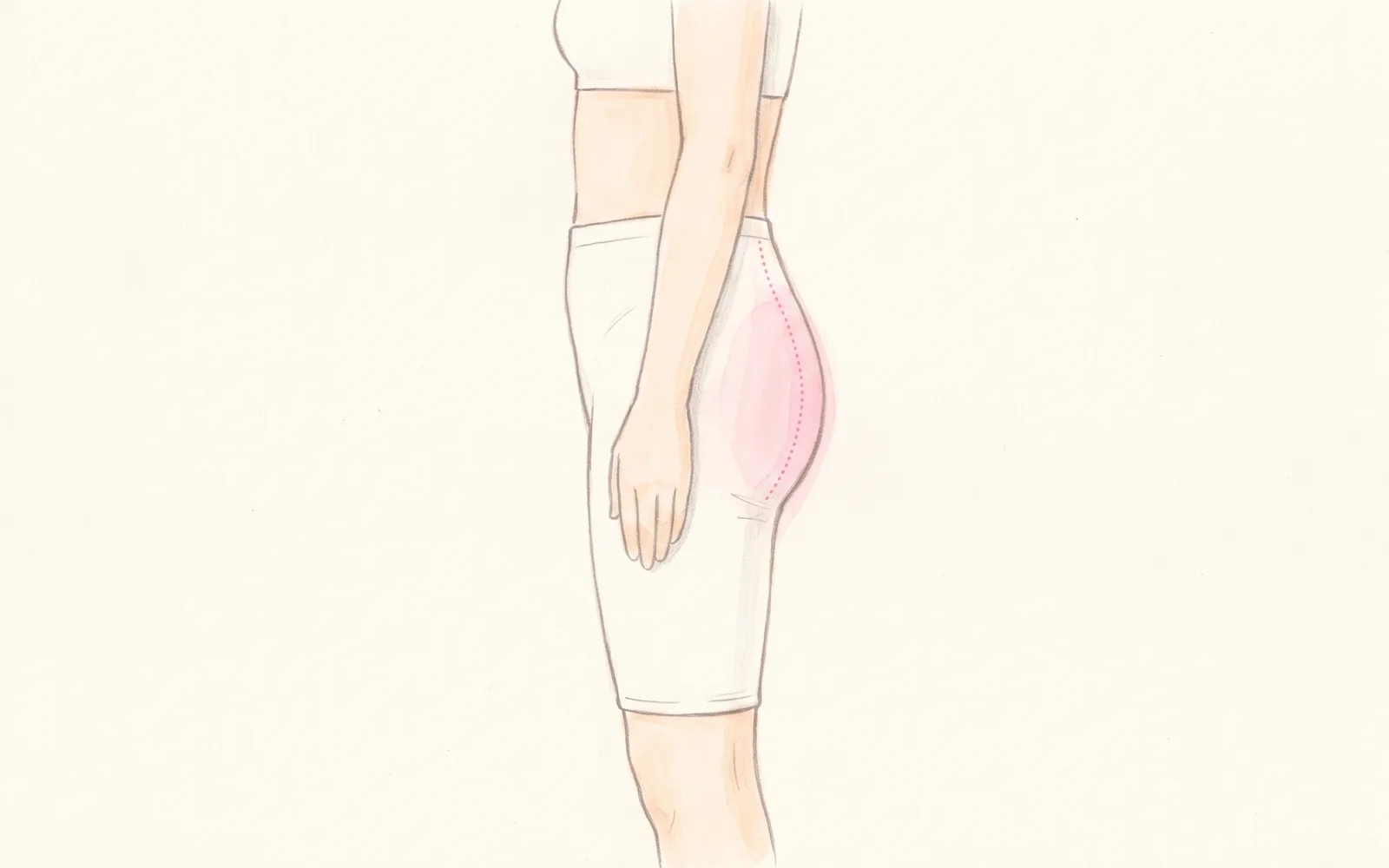
The illustration is an explanatory illustration to aid understanding, and procedure results vary by individual. The actual method is determined individually during consultation.
Considerations before Buttock Filler treatment
Buttock Filler — KakaoTalk 1:1 consultation
Area condition and prior procedure history — You can make a preliminary inquiry via KakaoTalk before your visit.
Buttock Filler, what changes can be expected?
Director Kwak Yeojin looks for the cause of sagging buttocks in «volume». When the area of the skin frame stays the same but the inner volume decreases, the surface loosens like a deflated balloon. Building pillars of volume with Filler in the upper and central buttock can create skin tension, which may also help lift the sagging skin below.
Raising the most prominent point of the buttocks can make the starting point of the legs appear higher, which may make the legs look longer. The degree of change varies by body type and injection volume.
How does the procedure proceed?
In consultation, we review body shape and the desired line, medications, allergies, and past procedures, then measure vessel locations and the thickness of skin and fat layers with ultrasound. Based on this, we design which layers to place and how much to divide.
Filler is stacked in layers within the firm fascia surrounding the gluteus maximus and in compartments of the fat layer. Rather than injecting a large amount at once, dividing the volume is the principle. Swelling and bruising after the procedure vary by individual.
If a lot of Filler is used, won’t it sag from the weight?
This was the question Director Kwak Yeojin pondered most when first starting Buttock Filler, and it is also the most frequently asked in consultations. The answer is sought in three properties of Body Filler and the fascial structure of the buttocks.
| Property | Meaning | Role in the buttocks |
|---|---|---|
| Viscosity | The property of staying in place without flowing down | Prevents downward pooling from the injection site |
| Elasticity | The property of returning to original shape after being compressed | Maintains volume shape even when compressed by sitting or movement |
| Cohesiveness | The property of particles attracting and holding together | Adheres to form a supporting structure for the buttocks |
※ However, if an excessive amount is concentrated in one area or placed in an unsuitable layer, it may appear bottom-heavy or form lumps, making the design of layers and volume important.
What do the gluteal muscles look like?
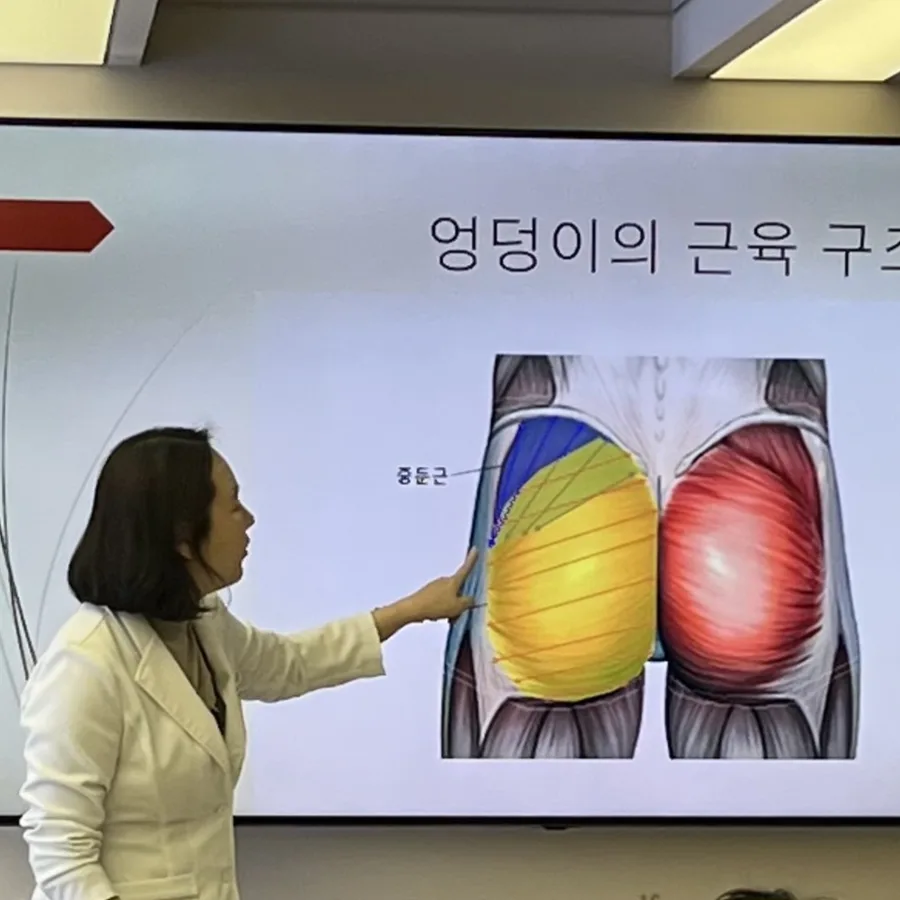
The gluteus medius at the outer upper buttock is originally a small muscle and is difficult to significantly enlarge through exercise; the hollow below it is the hip dip. Areas that are less developed and sunken become key targets for filling with Filler.
Buttock Filler frequently asked questions
Buttock Filler outcomes and duration vary depending on body type, injection volume, and product characteristics, and precise evaluation through consultation is necessary.
What products are used for Buttock Filler?
ImageUp Plastic Surgery uses body filler products such as e.p.t.q. eve s plus (Eptiq eve s plus)·SketchFill according to the area and purpose. The products used are explained during consultation.
If more than 1,000cc of Filler is injected, won’t it sag more due to the weight?
Director Kwak Yeojin says the same concern existed at first. Building pillars of volume with Filler in the upper and central buttock can create tension in the previously lax skin and tissues as a whole, which may help pull up the sagging skin below.
Filler layered within the firm gluteus maximus fascia and fat compartments is designed to act as a support from below, not as a downward-pulling weight. Effects vary by individual.
How many cc of Filler are typically used for Buttock Filler?
It depends on body type and the desired shape. In a lean-body example introduced on Director Kwak Yeojin’s blog, about 1,100–1,200cc were used to round out the entire buttock. The required amount is determined after consultation and ultrasound assessment.
Why doesn’t hip dip fill in even with diligent exercise?
Lean body types have a very thin subcutaneous fat layer. Even if the gluteus maximus and gluteus medius grow with exercises like squats, the sunken subcutaneous fat layer does not fill in, so hip dip can actually look more pronounced. The gluteus medius is originally a small muscle, so there is a limit to how much it can grow with exercise.
If I remove fat from the buttocks, won’t that lift the hips?
Dr. Kwak Yeojin says that after performing liposuction for a long time, she initially thought removing fat from the lower buttocks would make them lighter and lift, but over time she observed cases where the size decreased yet they looked more saggy. This is because the skin area remains the same while only the internal volume is reduced. Therefore, the doctor does not suction fat from the infragluteal fold.
Do you perform an ultrasound examination before the procedure?
Yes. Large arteries (superior and inferior gluteal arteries) and the sciatic nerve pass through the buttocks, and their depth and path vary slightly from person to person. Dr. Kwak Yeojin checks the locations of vessels and nerves and the thickness of the skin and fat layers with ultrasound before the procedure, then determines the injection plane and amount.
Why are hyaluronic acid (HA) fillers used for buttock filler?
Dr. Kwak Yeojin explains that the larger the injection volume, as in the buttocks, the more important it is to use hyaluronic acid (HA) filler that can be reversed if issues arise. HA filler can be dissolved with an enzyme injection called hyaluronidase, and retouching or design adjustments can be done as the body changes with age or weight fluctuations.
What should I check during a buttock filler consultation?
Dr. Kwak Yeojin recommends checking three things: whether ultrasound is used before the procedure to measure vessel locations and tissue thickness; whether the filler used is hyaluronic acid (HA) that can be dissolved; and whether the product is divided into multiple layers rather than injecting a large amount at once.
Can lean body types get buttock filler?
Yes. Most people to whom Dr. Kwak Yeojin has administered buttock filler have been lean. However, because the fat layer is thin, even a slight mistake in depth can make the filler palpable or look bumpy, making the procedure more demanding. In such cases, the doctor uses ultrasound to assess subcutaneous fat thickness and stacks the product dividedly over the fascia covering the muscle.
Who is buttock filler suitable for?
People concerned about flat buttocks lacking volume, those whose legs look short due to hip dips, and those who want noticeable changes but feel burdened by surgery often seek consultations. The slimmer the waist and the less buttock volume there is, the more apparent the change tends to be.
Does buttock filler migrate down into the thighs?
Dr. Kwak Yeojin explains three points: the fascia surrounding the gluteus maximus is thick and sturdy, acting as a wall together with surrounding fibrous septa; once filler is placed, the body forms a thin fibrous capsule that helps it stay within a defined space; and body-specific HA fillers have high viscosity, elasticity, and cohesiveness, helping them maintain a cohesive mass.
Stories about filler “sliding down” often come from non-degradable, semi-permanent fillers that are no longer used. However, if an excessive amount is injected or it is placed in an inappropriate plane, migration or clumping can occur.
Are there any side effects?
Immediately after the procedure, swelling and bleeding from injections may occur. In the early period, the area may feel firm or uneven due to swelling.
However, if a distinct lump persists over time or redness, warmth, or pain accompanies it, you should consider not only simple filler clumping but also possibilities such as inflammation or nodules. A delayed inflammatory reaction may occur long after the filler procedure, with swelling, redness, or firm nodules appearing at the injection site. Because various causes such as infection or immune reactions may be involved, it is important to confirm the cause through medical evaluation rather than assuming it is simply filler clumping and massaging or self-treating.
If filler enters a blood vessel or compresses it and obstructs blood supply, vascular occlusion can occur and lead to serious complications such as skin damage. If severe pain persists right after the filler procedure, the skin turns white, or mottled color changes appear, you should check for the possibility of circulatory compromise rather than simple swelling or bruising. Because vascular occlusion requires rapid judgment and management, if these symptoms appear, do not wait—contact the clinic that performed the procedure immediately and receive care.
During the pre-procedure consultation, we review personal risk factors such as medications, allergies, and past procedure history. Depending on the individual, side effects such as bleeding, infection, swelling, asymmetry, and scarring may occur and vary in degree, so please decide after sufficient consultation with a specialist.
Are there any post-procedure precautions?
Right after the procedure, it is best to avoid heavy drinking, strenuous exercise, and saunas, which can increase bruising and swelling. Also, unless specifically instructed by medical staff, do not press hard or massage the injection area on your own to “shape” the filler. Care methods may vary depending on the treated area and the product used.
I’ve had filler in another area before—should I mention it during consultation?
Yes. If you know the location, timing, and type of your existing filler, please share it during consultation. It will be taken into account in the treatment plan.
Can I get it during pregnancy or while breastfeeding?
If you have pregnancy or breastfeeding plans, please inform us during the prior consultation. We will adjust the procedure timing together depending on individual circumstances.
How do I book a buttock filler consultation?
You can receive guidance to book a consultation via KakaoTalk 1:1 or by phone (+82-2-555-1550).
Can I get a consultation on Saturdays?
On Saturdays, consultations are available from 10:00 am to 4:00 pm. On weekdays, Monday–Thursday 10:00 am–7:00 pm, Friday until 9:00 pm, and closed on Sundays and public holidays.
How long does Buttock Filler last?
Buttock Filler outcomes and duration vary depending on body type, injection volume, and product characteristics, and precise evaluation through consultation is necessary.
Depending on the individual, side effects such as bleeding, infection, swelling, asymmetry, and scarring may occur, and the degree may vary. Please make your decision after sufficient consultation with a specialist.
Check other body filler areas as well
For additional inquiries, contact us via KakaoTalk
1:1 KakaoTalk pre-inquiry — Mon–Thu 10:00 - 19:00 · Fri 10:00 - 21:00 · Sat 10:00 - 16:00.