

Facial Contouring
We consult based on the overall balance of the face
Facial Contouring is surgery that corrects the shape of facial bones such as the cheekbone, lower jaw, and chin tip to refine facial proportions. ImageUp Plastic Surgery first identifies where on the face causes it to look wide, then decides through consultation whether to correct only the necessary areas or to correct multiple areas together. Rather than excessively reducing bone, we consider the overall balance and three-dimensionality of the face together.
At a Glance
Facial Contouring is surgery that identifies which of the cheekbone, square jaw, or chin tip actually makes the face look wide, and corrects only as much as needed. Surgery is performed under general anesthesia, and because square jaw or chin tip surgery mainly uses intraoral incisions, visible external scarring tends to be limited. The degree of scarring may vary from person to person.
An inpatient ward is in operation, and contouring surgery is performed with a 1-day hospital stay. Recovery takes about 2 weeks, though it may vary from person to person. A specialist anesthesiologist is on site during contouring surgery.
Choose and view by facial contouring method
In addition to square jaw, cheekbone, and chin surgery, forehead bone reduction and augmentation and two-jaw surgery are also performed.
Facial Contouring: What is checked during consultation?
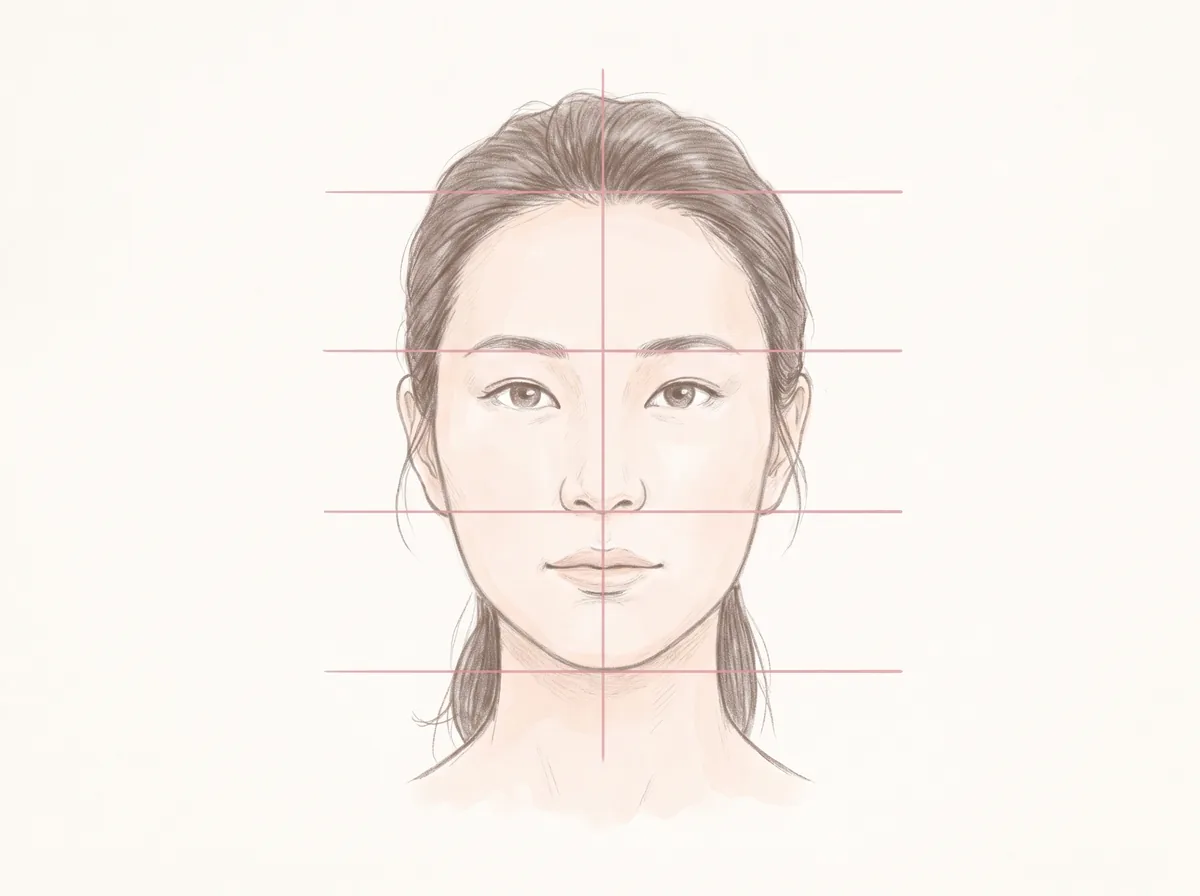
Identify causes of a wide-looking face
Facial size is influenced not only by bone but also by muscles, fat, and skin thickness. You do not necessarily need to do cheekbone, square jaw, and chin tip together; first identify the area that is the actual cause.
Incisions and scars
Because square jaw or chin tip surgery mainly uses intraoral incisions, visible external scarring tends to be limited. The degree of scarring may vary from person to person. Depending on the cheekbone reduction method, small additional incisions may be made not only inside the mouth but also in the scalp or around the ear.
Recovery and swelling
Swelling may feel more severe around 2–3 days after surgery than immediately after, and it takes considerable time for residual swelling to subside and for the facial lines to settle.
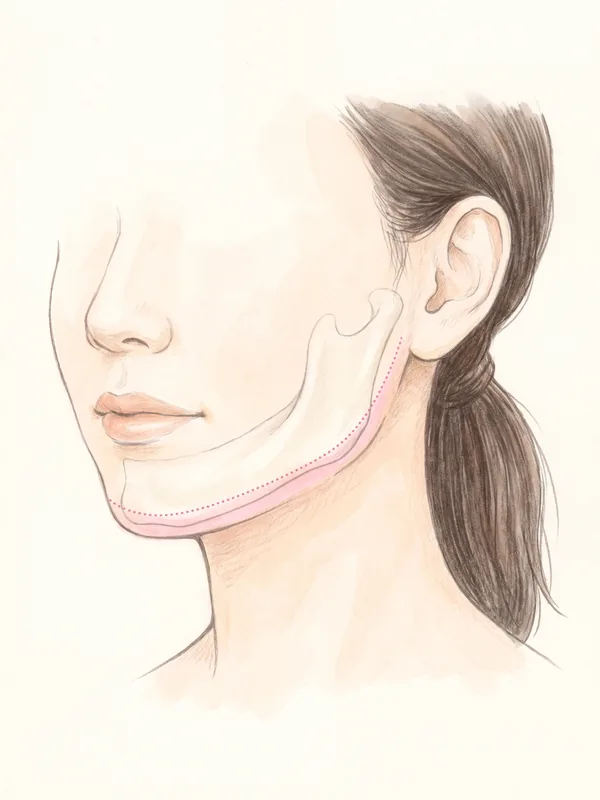
- Long-curve square jaw reductionThe lower jawline from the jaw angle below the ear toward the chin is resected in a long curve. Instead of cutting only the jaw angle, the resection continues forward, and the range is determined by considering both the lateral line and the frontal width.
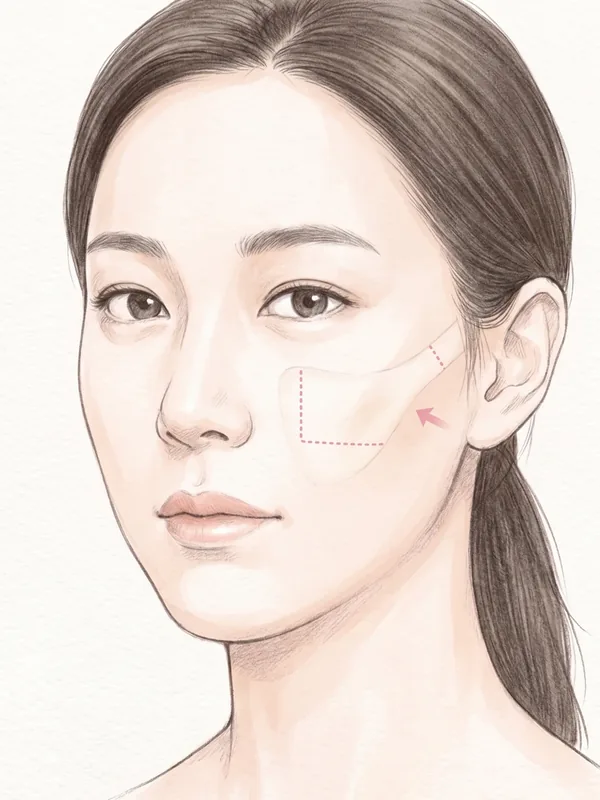
- L-osteotomy cheekbone reductionThe cheekbone is osteotomized in an L shape and then moved inward. The amount of bone cut and the distance moved are determined according to the degree of cheekbone protrusion.
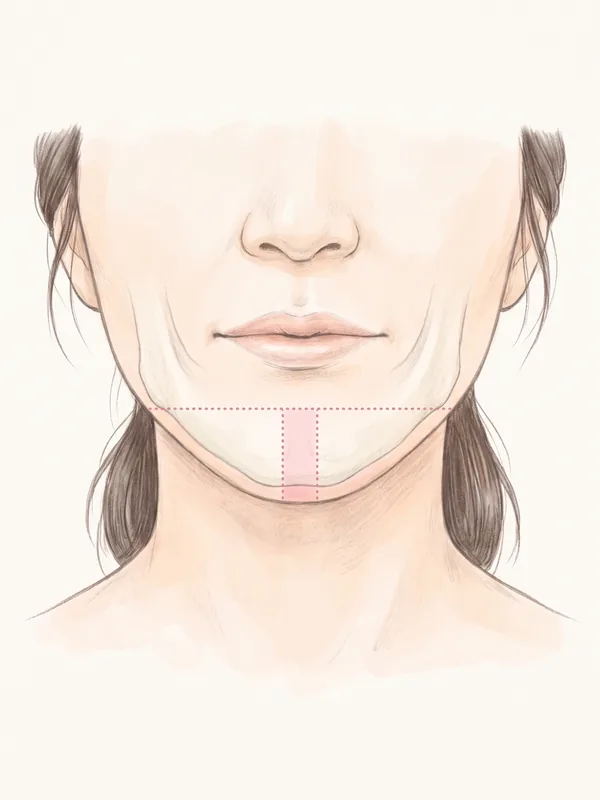
- Chin tip surgeryThe shape and length of the chin tip, and its anteroposterior position, are corrected. The chin tip is moved forward or backward, or the length of a long chin is reduced.
- Long Chin
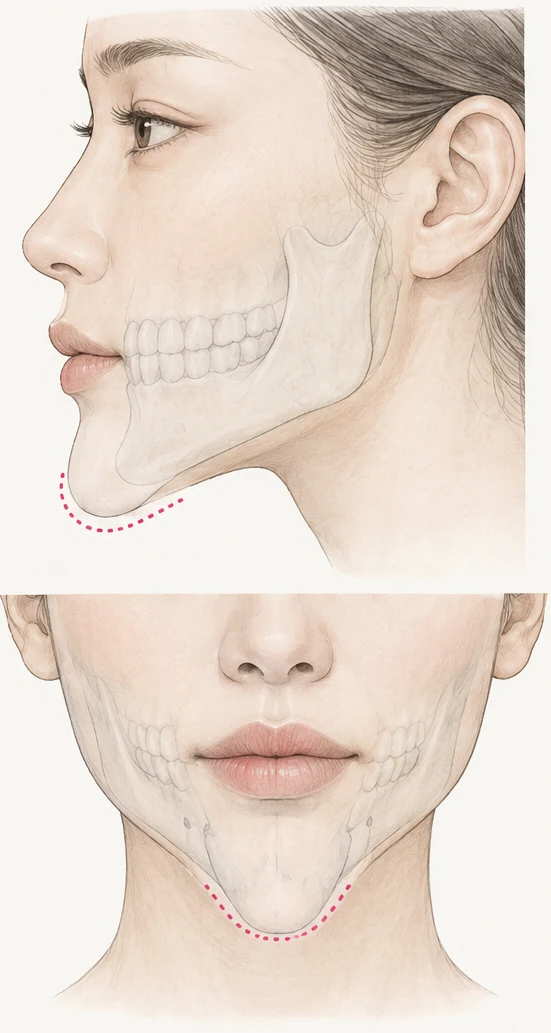
- Short, Blunt Chin
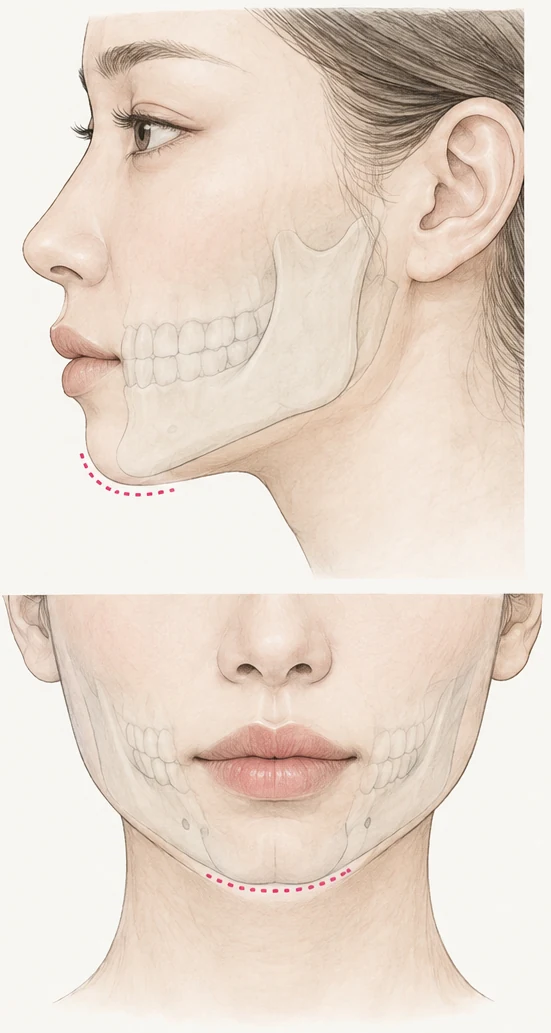
- Wide Jaw
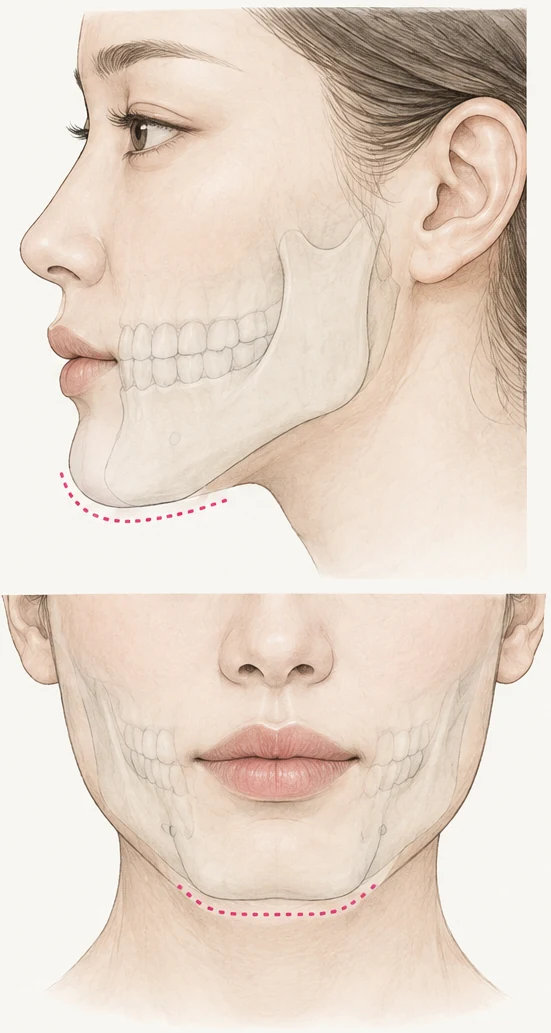
- Receding Chin
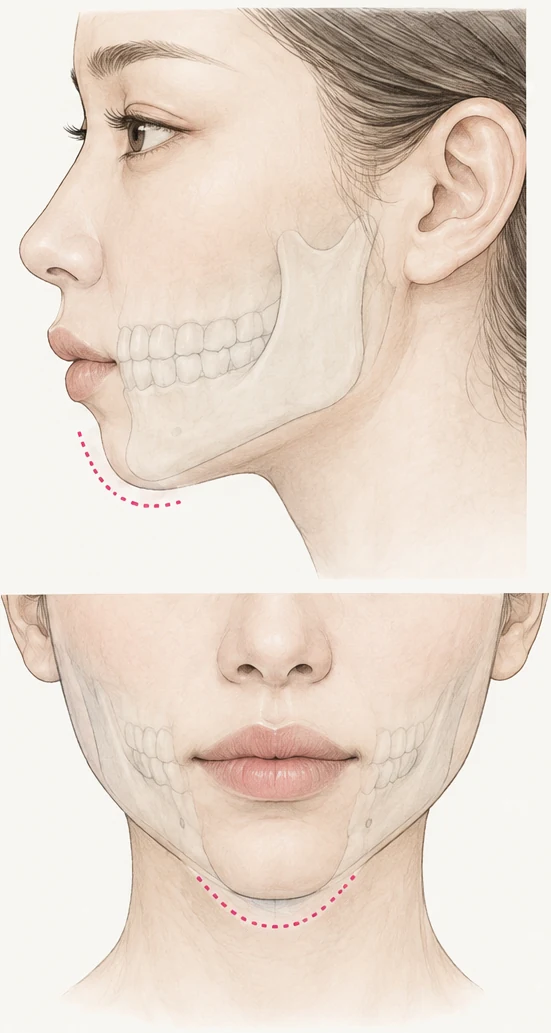
Facial Contouring — KakaoTalk 1:1 Consultation
You can make a prior inquiry via KakaoTalk before your visit about which area concerns you.
Does shaving more bone make the face smaller?
The goal of facial contouring surgery is not to reduce as much bone as possible, but to create overall balance and proportion of the face. If you reduce bone excessively, the facial balance may be disrupted or an unnatural contour may result.
With the cheekbones, it’s not about making them unconditionally small, but which parts are reduced and moved, and by how much. If you overly reduce even the anterior cheekbone that creates facial three-dimensionality, the face can look flat, so we plan by considering the degree of protrusion from both the front and side views together.
What is Camo Two-Jaw?
A beautiful face without moving the upper/lower jaw bones
If there are no functional problems of the jaw and teeth due to jawbone malposition or malocclusion?
Camo Two-Jaw is a surgery developed to prevent indiscriminate two-jaw surgery; without moving the upper/lower jaw bones, it combines the chin tip, nasolabial fold, anterior cheek, and Rhinoplasty to create a beautiful face.
Nasolabial Fold & Anterior Cheek Fat Grafting
If the nasolabial fold and anterior cheek areas are hollow or lack volume, it can make you look older.
- STEP 01
Delicate, meticulous fat harvesting with the handmade (SAL) method
- STEP 02
Isolate only pure fat
- STEP 03
Micro fat grafting to areas that need volume
Instead of grafting a large amount of fat at once, it is injected finely by separating the layers of the skin.
Fat harvesting sites: Abdomen, Thighs
Rhinoplasty
We perform in-depth analysis of the nose’s shape and structure to improve aesthetic and functional aspects.
We design a nose shape and line that harmonize with the whole face by considering the nose–forehead line, the distance between the brows, the angle with the lips, and more.
Frequently Asked Questions
After chin surgery it feels like the bone is getting bigger—can an adult’s jawbone grow?
Question details: I had anterior chin surgery through Facial Contouring, and I feel like the bone is getting bigger. Since I’m an adult and past the growth period, I’m wondering whether the chin can grow after surgery.
If the growth period has ended, bone does not grow. If your skeleton enlarges or bones grow after adulthood regardless of surgery, it is advisable to have hormone testing.
In the past year I developed a 45-degree cheekbone; is there any way other than shaving it down?
Question details: Over the past year, a 45-degree cheekbone has become prominent. Before growth ends, does the facial shape change a lot, and is shaving the only way to eliminate a 45-degree cheekbone?
Bone growth occurs until the late teens. In the cheekbone area there is bone, but also subcutaneous fat and other tissues under the skin, so there are many factors to consider, and it changes with weight and age. Try not to be too stressed, and visit a clinic around your late teens to undergo a CT scan, etc., for an accurate diagnosis.
If I have contouring surgery, will my face really become much smaller?
Question details: My wish is for my face to look smaller.
How small the face appears varies depending on the original facial shape, bone size, and the thickness of the soft tissues. In particular, if the cheekbones are highly protruded or the lower jaw is wide, the change can be relatively pronounced. However, facial size is influenced not only by bone but also by muscles, fat, and skin thickness, so reducing a lot of bone does not necessarily make the face small.
Do the 3 types of contouring have to be done all at once?
Question details: I’m wondering whether cheekbone surgery, square jaw surgery, and chin tip surgery must all be done together. I’m only concerned about my chin.
Not necessarily. It is important first to identify which area actually makes the face look wide. If only the cheekbones are developed, cheekbone surgery alone may be sufficient, and in some cases the overall facial proportions improve only when the lower jaw or chin tip are corrected together.
Is contouring surgery very painful?
Question details: I’m very scared that it will hurt because it’s bone-shaving surgery.
The surgery is performed under general anesthesia, so you do not feel pain during the procedure. After surgery there is pain, but many patients feel facial swelling and tightness or discomfort inside the mouth more than pain. The degree of pain and the speed of recovery vary from person to person.
After contouring surgery, when is the face the most swollen?
Question details: From the before–and–after photos, it seemed to swell a lot.
In general, swelling can feel worse around 2–3 days after surgery than immediately after. Thereafter, the major swelling gradually subsides, but it takes considerable time for the residual swelling to go down and for the facial lines to settle naturally.
I have to go to work; after surgery, when can I return to the office?
Work or classes themselves may be possible relatively early, but the issue is swelling. Depending on whether you need to meet many people and whether you can wear a mask, the actual return time varies. If you have an important interview, shoot, or wedding, it is better to schedule surgery with sufficient recovery time.
Is it true that cheeks sag after facial contouring surgery?
Question details: I saw on YouTube that if you shave the cheekbones, the face will droop and you should never do it.
Not everyone develops cheek sagging after facial contouring surgery. However, as the shape of the bone changes, the position and support structures of the surrounding soft tissue can also be affected. Depending on preoperative skin elasticity, fat volume, age, and the extent of surgery, how pronounced sagging appears after surgery can vary.
Does removing more bone make the face smaller and prettier?
Question details: My bones are really large so I want to reduce as much as possible; I’m wondering if the clinic will do that.
No. The goal of facial contouring surgery is not simply to reduce as much bone as possible, but to create overall facial balance and proportions. If you reduce the bone excessively, facial harmony can be disrupted or an unnatural contour can result, so it is important to design within a range that can be reduced safely.
If I have cheekbone surgery, won’t the front cheekbone also disappear and make the face look flat?
Question details: I’m worried my face will become peanut-shaped after surgery.
For the cheekbone, it is not about making it as small as possible; what matters is which parts are reduced, by how much, and how they are moved. If you excessively reduce even the front cheekbone that creates facial three-dimensionality, the face can look flat. Therefore, we plan surgery by considering the degree of projection from the front and side views along with the overall facial three-dimensionality.
Is square jaw surgery shaving the jaw straight and long?
Question details: When I look at celebrities, some look like they have a dog-jaw appearance; I wonder if surgery makes everyone like that.
It is not just about cutting off the protruding mandibular angle. You need to consider the width of the lower jaw as seen from the front, the jawline as seen from the side, and the line continuing to the chin tip. Because the shape of the lower jaw differs by person, the resection range and method can vary.
My chin tip is short; if I only do square jaw surgery, won’t my face look shorter and rounder?
That is possible. If you only reduce the width of the lower jaw and the length or projection of the chin tip does not match the overall facial proportions, you may not achieve the desired contour. In such cases, it is better to plan surgery after also assessing the length and position of the chin tip.
Can facial contouring surgery cause loss of sensation in the chin or lips?
Question details: I’ve heard some people say they have no sensation at all.
Sensory nerves run near the surgical area, so after surgery the sensation of the lips, chin, or cheeks can be dulled or feel different than usual. Many cases improve over time, but depending on the degree of nerve injury, sensory changes may persist for a long time. Therefore, before surgery it is important to check the nerve location and bone structure with CT, etc.
If surgery is performed through the mouth, are scars completely invisible?
Question details: I’m worried about scars; do scars also form inside the mouth?
Square jaw or chin tip surgery mainly uses intraoral incisions, so visible external scarring tends to be limited. The degree of scarring may vary from person to person. For cheekbone surgery, depending on the method, small additional incisions may be made not only inside the mouth but also in the scalp or around the ear.
After surgery, when can I eat properly again?
Question details: I’m also wondering whether I won’t be able to eat at all after surgery.
In the early period, due to intraoral incision sites and swelling, chewing as usual can be uncomfortable, so you will mainly take soft foods. While the bone is stabilizing, very hard or tough foods should be avoided, and the timing of returning to a normal diet should follow guidance from the medical team according to the surgical method and your recovery.
After facial contouring surgery, can the shaved bone later grow back and return to the original?
Question details: I’m worried it might get big again after surgery.
In adults, it is not typical for bone resected by surgery to regrow to its original shape. However, over time, changes in body weight, muscles or fat, and skin aging can alter the facial outline, making it feel different from right after surgery.
It’s day 7 after surgery; is it okay if only one side of the face is more swollen?
Postoperative swelling does not necessarily occur identically on both sides. Depending on the surgical extent, amount of bleeding, or preexisting facial asymmetry, one side may appear a bit more swollen. However, if only one side suddenly swells severely or the swelling rapidly increases with severe pain or a hard feeling, you should contact the clinic.
People say that for contouring they stitch up the whole inside of the mouth; after surgery, can I not brush my teeth?
When there is an intraoral incision, oral hygiene after surgery is important. However, in the early period, be careful not to directly irritate the surgical area with a toothbrush, and you can also use mouthwash as instructed by the clinic. The timing for starting regular toothbrushing should be guided according to the condition of the incision sites.
After facial contouring surgery, is it okay if food gets caught in the intraoral stitches?
Question details: I was told it was sutured with dissolvable stitches, but I can feel the stitches in my mouth.
If food remains around intraoral incision sites, it can cause inflammation, so it is important to keep the mouth clean after meals. However, please avoid continually touching the sutures with your fingers or tongue or forcibly trying to remove food.
After facial contouring surgery my mouth doesn’t open well; is my temporomandibular joint damaged?
After facial contouring surgery, due to swelling and tension of the surrounding muscles, it can be temporarily difficult to open the mouth wide. Many cases gradually improve as recovery progresses. However, if there is no improvement over time at all, or if difficulty opening the mouth is progressively worsening with pain, a check by the medical team is needed.
Do I have to wear a compression band?
Question details: The clinic told me to wear a compression band; is wearing it 24 hours or longer always better?
A compression band can help with early swelling control, but wearing it longer is not necessarily better. Excessively strong or prolonged compression can burden the skin and soft tissues, so it is best to follow the wearing method and duration instructed by the clinic.
To reduce swelling, they say to use cold packs; for how many days should I do it?
In the immediate postoperative period, cold compresses can help reduce swelling and discomfort. However, avoid placing ice directly on the skin or applying cold for excessively long periods. The need for cold or warm compresses varies by postoperative stage, so please follow the clinic’s guidance.
I heard the bone is shaved and removed and fixed with pins; after cheekbone reduction, is it okay to sleep on my side?
In the early postoperative period, if possible, sleep on your back with your upper body slightly elevated. Sleeping face down or pressing one side of the face against the pillow can put pressure on the surgical area, so it is best to avoid such positions at first.
After surgery, when can I drink alcohol and smoke again?
Question details: I’m wondering whether I must not smoke, and what about e-cigarettes?
Alcohol can affect swelling and bleeding, and smoking can negatively affect blood circulation and wound healing. Especially in the early postoperative period, avoiding alcohol and smoking is important. The time to resume should be discussed with the medical staff depending on the recovery status of the wound and bone. E-cigarettes also contain nicotine and tar, so it is best not to smoke them for at least about one month.
When can I start exercising again?
Question details: I’m also wondering whether I can swim.
Light walking can help with recovery, but you should avoid vigorous exercise such as running or weight training from the beginning. In particular, exercises with a possibility of impact to the face should be avoided until the bones are sufficiently stable. The timing to resume exercise varies depending on the surgical extent and recovery status.
It’s the 2nd week after surgery and my cheekbones or square jaw still look prominent—was the surgery insufficient?
Question details: I’m also wondering whether I should ask to shave more, and whether this is a side effect.
In the early postoperative period, your face may actually look wider or larger than before surgery due to swelling. Especially while swelling remains around the cheekbones or lower jaw, it is difficult to judge the final contour. Even after major swelling subsides, residual swelling and tissue settling are needed, so results should be evaluated with sufficient recovery time.
It’s been 3 weeks after surgery and the sensation in my chin or lips is still dull—when will it return?
After facial contouring surgery, sensation around the surgical area may become dull or feel different than usual. Even if the nerve itself was not directly injured, temporary sensory changes can occur due to swelling of surrounding tissues or nerve irritation during the procedure. Recovery varies by individual, and if sensory decrease persists or worsens, follow-up evaluation is needed.
After facial contouring surgery, my mouth shape and facial expression look awkward when I smile—was a nerve affected?
Question details: I’m very worried because my mouth shape looks awkward and my expression looks strange when I smile.
Immediately after surgery, movements of the lips or cheeks may feel different from usual due to swelling, tissue tension, and sensory changes. Many cases become more natural as swelling decreases. However, if a clear asymmetry of movement persists, it is advisable to be examined by medical staff.
My skin seems saggy after facial contouring surgery—can I get lifting right away?
Question details: I heard that skin becomes loose and sags a lot after facial contouring surgery, and I think that’s my case.
In the early postoperative period, it is difficult to accurately judge actual skin sagging due to swelling. It is better to evaluate skin laxity after the bone and soft tissue have stabilized to some extent and swelling has sufficiently subsided. If needed, appropriate lifting treatments can be considered later depending on skin condition.
I regularly received Botox for the forehead, chin, and eye area. After facial contouring surgery, when can I get Botox or filler?
After facial contouring surgery, you can receive Botox or filler as needed. However, immediately after surgery it is difficult to accurately judge facial shape due to swelling and tissue changes, and caution is needed depending on the treatment area. After sufficient recovery, evaluate the current facial status to decide on necessary treatments.
After facial contouring surgery, when can I know the final facial shape?
Question details: It feels like my face has gotten bigger, as if the swelling isn’t going down after surgery.
Major swelling subsides relatively early, but residual swelling and firmness can persist longer. It also takes time for the soft tissues around the bone to adapt and settle into the new contour. Therefore, rather than judging the result based on the appearance in the few weeks after surgery, it is better to observe changes over several months.
Depending on the individual, side effects such as bleeding, infection, swelling, asymmetry, and scarring may occur, and the degree may vary. Please make your decision after sufficient consultation with a specialist.
Facial Contouring — KakaoTalk 1:1 Consultation
You can make a prior inquiry via KakaoTalk before your visit about which area concerns you.