

Arrow Nose/Long Nose
What are drooping tip and long nose?
Drooping tip/long nose refers to a shape where the nasal tip droops downward or the nose appears long relative to the face. In particular, the action of the muscle that pulls the tip downward when smiling can make the tip look even more drooped.
At ImageUp Plastic Surgery, we comprehensively analyze the shape and position of the tip cartilages, the length and support structure of the septum, the tip rotation angle, and the nasolabial angle. Depending on the cause, excessively long or descended septum and tip structures are adjusted, and the drooping tip is rotated and repositioned upward to create a natural nose length and tip angle that match facial proportions.
Drooping tip/long nose surgery process
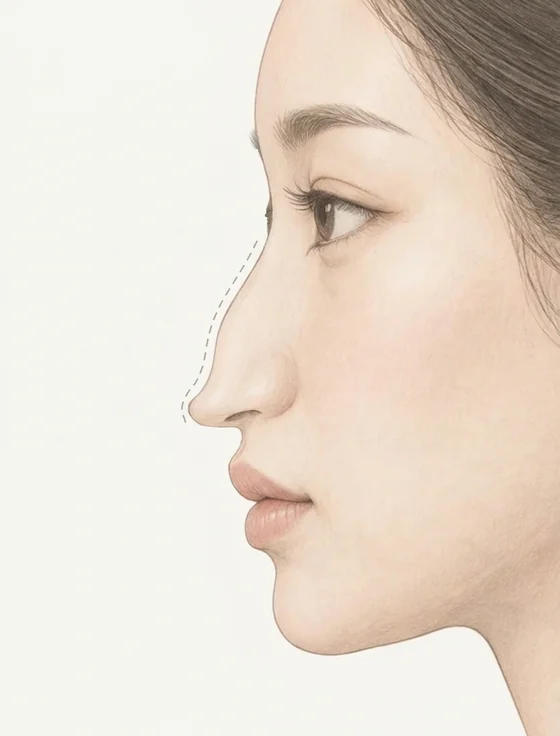
- 1Before surgeryCheck the overall nose length, the degree of tip droop, the nasolabial angle, and vertical facial proportions. The movement of the tip is also evaluated, such as whether the tip descends further when smiling, to design the range and direction of correction.
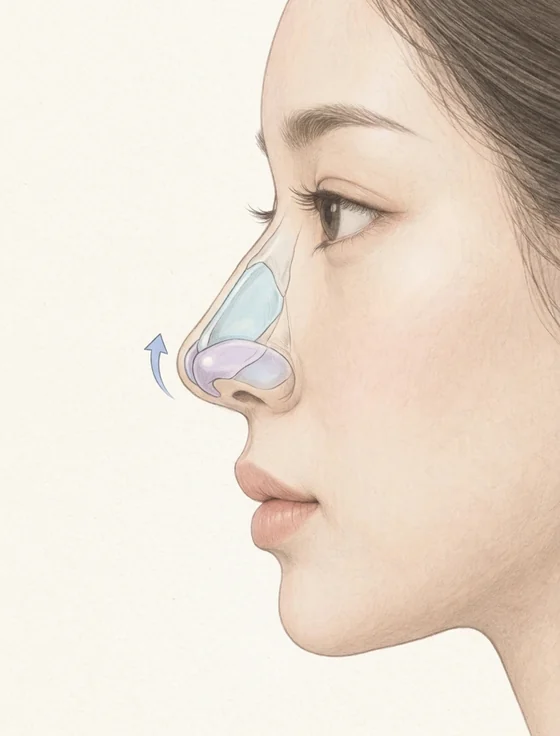
- 2Correction of drooping tip and long noseAdjust the elongated or downward-descended septum and tip cartilages as appropriate, and rotate/reposition the tip cartilages upward to correct nose length and tip direction. If necessary, the muscle that pulls the tip downward Depressor septi nasi muscle (Depressor septi nasi muscle)Adjust and reinforce the nasal tip support structure using autologous cartilage.
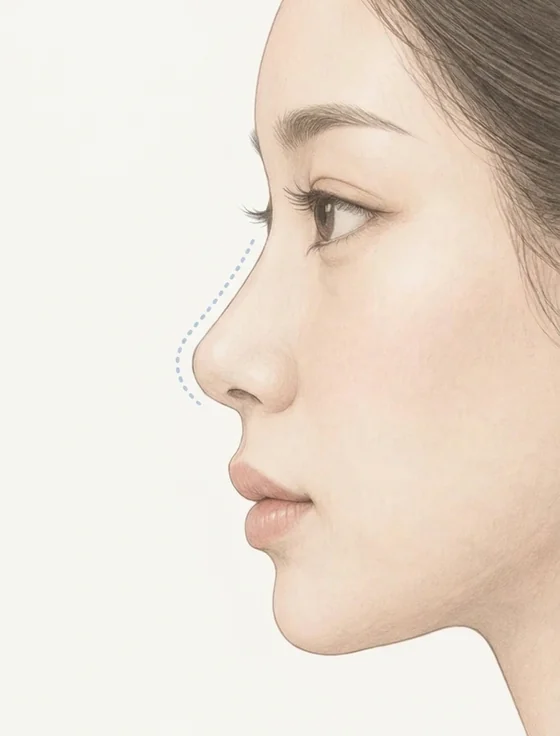
- 3After surgeryThe downward-drooping nasal tip is naturally lifted and the excessively long-looking nasal length is improved. The position of the tip, the nasolabial angle, and the connection between the bridge and the tip are checked while finishing with consideration for harmony with the entire face.
Key points of Droopy Tip/Long Nose surgery
Droopy Tip/Long Nose surgical methods
Alar cartilage reshaping
Fix the descended alar cartilage to the septal cartilage.
Septal correction
If the septal cartilage is long and appears droopy, excise the lower portion of the septal cartilage and readjust its position.
Droopy Tip/Long Nose — KakaoTalk 1:1 consultation
If you are curious about your previous surgical history or your current nose condition, you can inquire via KakaoTalk before consultation.
Arrow Nose/Long Nose Frequently Asked Questions
My nose is long and the tip droops downward. Is this an arrow nose?
If the nasal tip appears to droop downward in profile or the nose looks long from the front, it may correspond to an arrow nose or a long nose. Multiple factors can have an effect, including the position and size of the nasal tip cartilage, the length of the septum, and the muscles that move the nasal tip, so it is important to first identify the exact cause.
When I smile, the tip of my nose drops more. Is this also an arrow nose?
It may not be severe at rest, but when you smile, the nasal tip can be pulled downward, making the nose appear longer. This can be caused by the action of muscles that pull the nasal tip downward or by the nasal tip support structures, so we examine both the usual appearance and the changes that occur with facial expressions.
For a drooping nasal tip, is it enough to lift only the nasal tip?
It is not resolved simply by lifting the nasal tip upward. It is important to check the shape and position of the nasal tip cartilage, as well as the length and support structure of the septum, and to appropriately adjust the position and rotation angle of the nasal tip.
If a long nose is shortened, won't the nose look too upturned?
The goal of long nose correction is not to make the nose short at all costs. Because the position and angle of the nasal tip are adjusted considering facial length, nasal proportions, the degree of nostril show, and other factors, correction is performed within an appropriate range so that the nose does not appear overly upturned.
My nasal bridge also looks long. Can it be corrected at the same time?
Not only the nasal tip but also the length and height of the nasal bridge and the presence of a dorsal hump can affect the impression of a long nose. If needed, the nasal bridge and nasal tip can be corrected together to adjust the overall line and proportions from the forehead to the nasal tip.
If I have both a drooping nasal tip and a Dorsal Hump, can they be treated in one surgery?
It is possible. When a dorsal hump and a drooping nasal tip are present together, the protruding nasal dorsum can be refined as needed and the position and angle of the nasal tip can be corrected together to adjust the overall nasal line.
Won’t the philtrum look longer after drooping nasal tip surgery?
When the position and angle of the nasal tip change, the proportions between the nose and the lips may also look different. Therefore, rather than designing based on the nose alone, it is important to also consider the angle between the nasal tip and the upper lip, philtrum length, and overall facial proportions.
My nasal tip is large and drooping. Can the size also be reduced at the same time?
When the nasal tip cartilage is large or splayed and droops downward, the width and shape of the nasal tip can also be improved while adjusting the shape and position of the cartilage. However, if the skin is thick, there may be limitations in the degree of change.
Is cartilage always used in drooping nasal tip surgery?
The same method is not used in every case. Depending on the condition of the existing nasal tip cartilage and septum, and on the required support and amount of correction, the existing cartilage may be repositioned, or, if needed, the support structure may be reinforced using autologous cartilage.
Can the nasal tip droop again after drooping nasal tip surgery?
Aging and tissue changes continue even after surgery, and if nasal tip support is weak or the skin and soft tissue are heavy, the position may change over time. Therefore, creating a stable support structure is more important than simply lifting the nasal tip.
What is checked before droopy tip surgery?
We check the overall length of the nose, how much the tip droops, the angle between the tip and upper lip (nasolabial angle), and the vertical proportions of the face. We also evaluate whether the tip drops further when smiling to decide the extent and direction of correction.
What is the nasolabial angle? Is it related to a droopy tip?
It is the angle between the nasal tip and the upper lip. A droopy tip is a shape in which the tip points downward, so when rotating and repositioning the tip upward, this angle is taken into account to balance the profile.
Is the muscle that pulls the tip down when smiling also adjusted surgically?
It is adjusted when necessary. By adjusting the depressor septi nasi muscle, which pulls the tip down, we also take into account the movement of the tip drooping further when smiling.
How is the length of a long nose reduced?
Depending on the cause, we adjust septum and tip structures that are excessively long or have descended, correcting the length of the nose. The goal is a natural nose length and tip angle that suit the facial proportions.
What are the steps of droopy tip/long nose surgery?
After the pre-operative evaluation, we adjust the long or downward-drooping septum and tip cartilage to suit the condition, and rotate and reposition the tip cartilage upward to correct the nasal length and tip direction. If needed, the tip's support structure is reinforced with autologous cartilage. Finally, we check the tip position, nasolabial angle, and the connection between the bridge and tip and finish while considering harmony with the whole face.
Depending on the individual, side effects such as bleeding, infection, swelling, asymmetry, and scarring may occur, and the degree may vary. Please make your decision after sufficient consultation with a specialist.
View together by rhinoplasty type
Please review our complete guide to Low Nasal Bridge, Upturned Nose, Arrow Nose, Deviated Nose, Dorsal Hump, Alar Reduction, revision rhinoplasty, and Rhinoplasty.
View rhinoplasty types and revision, with 3D CT analysis, on one page.
NOSE Low Nasal BridgeLow nasal bridge surgery can be performed in various ways depending on the height and shape of the nose, skin thickness, and overall facial proportions.
NOSE Upturned Nose/Short NoseAn upturned or short nose refers to a shape in which the length of the nose is relatively short or the nasal tip is lifted upward so that the nostrils are highly visible from the front.
NOSE Deviated NoseA deviated nose refers to a shape in which the nasal bridge or nasal tip bends to one side away from the facial midline, making the nasal line appear asymmetric.
NOSE Dorsal HumpA dorsal hump refers to a shape in which the nasal bone and cartilage forming the nasal dorsum are overly developed or protruding, so that the middle portion of the nasal dorsum appears bulged in profile.
NOSE Alar ReductionAlar reduction is a surgery that adjusts the width and shape of the alar to create a more balanced nose shape when the alar is widely spread to the sides or the nostrils appear large, making the nose look wide and blunt.
NOSE Revision RhinoplastyRevision rhinoplasty is surgery performed when, after a previous rhinoplasty, the shape of the nasal bridge or tip is unnatural or asymmetry has developed, or when further correction is needed due to implant malposition or showing through, nasal tip deformity, contracture, or similar issues.
Droopy Tip/Long Nose — KakaoTalk 1:1 consultation
If you are curious about your previous surgical history or your current nose condition, you can inquire via KakaoTalk before consultation.