

Wound & Laceration Repair
We handle everything from emergency treatment to care after suture removal.
When a wound occurs, first apply firm pressure with clean gauze or a towel to stop the bleeding; if the wound is contaminated, rinse it gently with running water or saline and protect it with clean gauze. If the wound is deep or gaping, or if it keeps bleeding, it is best to visit a medical facility as soon as possible for an accurate examination.
At ImageUp Plastic Surgery, we do not simply close the wound; we check the depth and direction of the wound and the degree of tissue damage and contamination, and after irrigation, debridement, and removal of foreign material, we suture the necessary tissue layers step by step. We then check how the wound is healing, remove the stitches at the appropriate time, and continue with scar care when needed.
At a Glance
Not every wound needs to be sutured
Small, shallow wounds may heal with cleaning and dressing alone. However, wounds that are deep or gaping with the tissue beneath the skin exposed, wounds that keep bleeding, and wounds in areas where scarring matters, such as the face, need an accurate assessment.
When suturing is needed, the wound is cleaned thoroughly, damaged or contaminated tissue is trimmed to the extent necessary, and then the subcutaneous and skin layers are each aligned and sutured step by step according to the depth of the wound.
Especially for facial wounds, accurately aligning the height and direction of the wound edges and reducing the tension on the skin matters more for minimizing future scarring than simply closing the skin surface.
These wounds need an accurate medical examination
- When the wound is deep and gaping
- When bleeding continues
- Wounds in cosmetically important areas such as the face, eyebrows, lips, and nose
- Wounds with dirt or foreign material in them
- When part of the skin is damaged or missing
- When damage to muscle or deep tissue is suspected
- When the wound has already been sutured but has reopened or is not healing well
What should I do first when I get a wound?
Emergency treatment consists of three steps.
- STEP 1
Apply pressure to stop the bleeding
Apply firm pressure to the wound for a while using clean gauze or a towel. Rather than repeatedly lifting the gauze to check the bleeding, it is important to keep applying continuous pressure.
- STEP 2
Protect the wound
If there is dirt or contamination, rinse gently with running water or saline and cover with clean gauze to protect it. It is best not to rub the inside of the wound directly or try to remove deeply embedded foreign material yourself.
- STEP 3
Visit a medical facility if needed
If the wound is deep and gaping, bleeding continues, foreign material has entered, or there is any abnormality in sensation or movement, it is best to seek medical care promptly.
Suturing step by step according to the skin layers
For deep wounds, suturing only the skin can concentrate tension on the wound.
When needed, the deep dermis and subcutaneous layer are sutured first with absorbable sutures to reduce wound tension, and the skin edges above are then aligned accurately and the skin layer is sutured.
This Layered Closure aims to restore damaged tissue close to its anatomical position and to reduce the tension concentrated on the skin surface.
Removing the sutures is not the end.
The timing of stitch removal depends on the location and depth of the wound, the suturing method, and the healing progress. Therefore, rather than going only by a set date, it is important to remove them at the appropriate time after checking the wound.
Even right after the stitches are removed, the wound tissue has not fully regained its strength, so care must be taken for a period of time to keep the wound from reopening.
Once the wound has stabilized, scar care such as taping, silicone gel or sheets, and sun protection can be carried out depending on its condition, and additional scar treatments such as injections and lasers may be considered depending on how the scar progresses, for example redness or raised tissue.
Wound treatment process
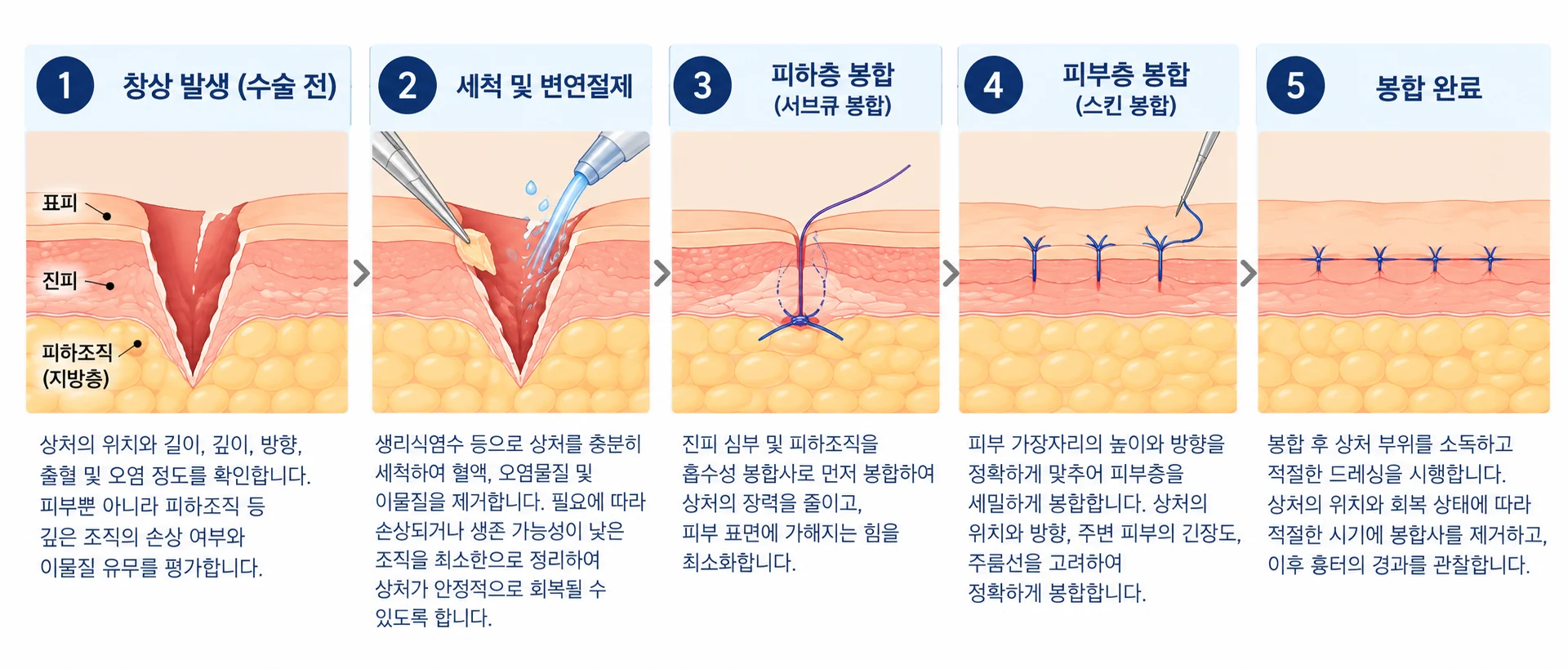
- 01
Checking the wound condition
The location, length, depth, and direction of the wound and the degree of bleeding and contamination are checked. Damage to deeper tissue such as subcutaneous tissue and muscle, not just the skin, and the presence of foreign material are also checked.
- 02
Irrigation and debridement
Thorough irrigation removes blood, contaminants, and foreign material from inside the wound. When needed, debridement—minimal trimming of damaged tissue or tissue with low viability—is performed to create an environment in which the wound can heal stably.
- 03
Suturing of deep tissue and the subcutaneous layer
For deep wounds, damaged tissue is arranged according to its anatomical position, and the subcutaneous layer is then sutured with absorbable sutures. Distributing wound tension from the deeper layers reduces the force applied to the skin surface.
- 04
Precise skin-layer suturing
The skin edges are aligned accurately in height and direction and sutured finely. Especially on the face, it is important to align the skin borders precisely in consideration of skin creases, the direction of the wound, and surrounding structures.
- 05
Dressing and follow-up observation
After suturing, the wound is disinfected and an appropriate dressing is applied. Depending on the wound location and healing progress, the stitches are removed at the appropriate time, and the scar's progress is monitored afterward.
Key points of wound closure
Wound & Laceration Repair — KakaoTalk 1:1 Consultation
You can make a pre-visit inquiry via KakaoTalk with a photo of the wound.
Frequently Asked Questions
My face just got cut—should I go to the emergency room or to plastic surgery?
If there is severe bleeding or suspicion of other major trauma such as decreased consciousness or fracture, it is important to be evaluated first in the emergency room. If your general condition is stable and the wound is a laceration of the facial skin and soft tissue, you can be assessed for wound depth and tissue damage and receive suturing treatment in plastic surgery.
The cut from a knife doesn’t look very open—does this still need stitches?
A wound that looks small on the surface can still be deep. If the skin is gaping or subcutaneous fat is visible, or if the wound keeps opening with movement, suturing may be necessary. Especially for areas like the face or hands where function and scarring are important, it is advisable to have it examined even if the wound is small.
I cut my face—do I have to get it sutured?
Question details: I’m wondering whether I can just leave it to stick together, and whether stitching will prevent scarring.
Not all wounds must be sutured. However, if the wound is deep or gaping and the tissues beneath the skin are damaged, accurately approximating and suturing can help control bleeding, stabilize the wound, and reduce scarring. The decision to suture is made after checking the depth, degree of contamination, and location.
My child’s forehead was cut by hitting a desk edge—can a child have suturing under local anesthesia?
Children can be sutured under local anesthesia depending on the size and location of the wound and their ability to cooperate. However, if a very young child moves severely or the wound is large and deep, sedation or other methods may be needed for safe suturing.
I fell and my face is cut and keeps bleeding—what should I do before going to the hospital?
Press the wound directly with clean gauze or a towel and maintain firm pressure for a set time—that is most important. Rather than repeatedly lifting the gauze to check because it is bleeding, it is better to apply sufficient pressure while going to the hospital. If bleeding is very severe or you have dizziness, emergency care is needed.
Sand or asphalt got into the wound—can it just be stitched up?
For contaminated wounds, it is important to thoroughly remove foreign material and irrigate the wound before immediate suturing. If sand or asphalt fragments remain in the skin, they can cause infection, and especially on the face they may later remain as dark spots. If needed, damaged tissue is debrided before suturing.
I was cut by a glass cup—do I just need stitches?
Question details: I’m wondering whether glass might be left inside the wound.
With cuts from glass, you need to check whether small glass fragments remain inside. If the wound is deep or foreign material is suspected, an examination and, if needed, imaging may be performed. Especially in the hand or fingers, you should also check for tendon, nerve, and blood vessel injury.
The wound is deep and I can see yellow fat inside—does that mean it’s very severe?
If yellow subcutaneous fat is visible, it’s likely a relatively deep wound with the full thickness of the skin opened. Rather than simply approximating the skin, it is better to check for damage and contamination of the internal tissues and, if necessary, suture stepwise from the layer beneath the skin.
When stitching a facial wound, do you also suture the inside of the skin?
If a wound is widely gaped, closing only the skin surface can place a lot of tension on the wound. When needed, the dermis or subcutaneous tissue beneath the skin is sutured first to reduce tension, and then the skin is precisely aligned and closed last. The layers to be sutured vary with the depth of the wound.
If you use dissolvable stitches, you don’t have to remove them—doesn’t that make them better?
Absorbable sutures and those that need removal each have pros and cons, and are chosen based on the wound’s location and depth. Absorbable sutures are often used in the deeper layers, but on the skin surface—especially in areas like the face where scarring is important—removable sutures are also frequently used. Absorbable sutures are not always better.
I heard the suture is a cosmetic suture; is it different from ordinary thread?
To prevent the wound from opening or a deep scar remaining, appropriate sutures are selected according to the skin layer. Fine sutures mainly used in cosmetic surgery are used to perform two- or three-layer suturing.
When are facial stitches removed?
Question details: I’m wondering if leaving them in longer makes it attach more firmly.
Keeping stitches in longer is not necessarily better. On the face in particular, leaving them too long can leave marks where the sutures passed, so they are often removed relatively earlier than in other areas. The exact removal timing is determined by the wound’s location and depth, the tension, and the healing status.
My lip is torn through to the inside—does that need suturing too?
The lip can involve not only the skin but also the oral mucosa and the lip muscle. If the wound is deep, it is important to identify the damaged layers and align each accordingly. In particular, if the border between the red part of the lip and the skin is misaligned, even a small mismatch can be noticeable, so it must be matched precisely when suturing.
My eyebrow is lacerated—do you have to shave the eyebrow to suture it?
In most eyebrow lacerations, there is no need to shave the entire eyebrow. The eyebrow can actually serve as a reference to precisely align the wound location and the skin on both sides. Only the necessary parts are tidied, and the existing eyebrow is preserved as much as possible during closure.
A little blood is oozing from the stitched wound—should I go back to the hospital?
Right after suturing, a small amount of blood or discharge can stain the gauze. However, if bleeding continues enough to keep soaking the gauze, or if the area around the wound suddenly becomes very swollen and firm, you should check for bleeding or a hematoma, so it’s best to contact the hospital or be seen.
The day after suturing, the wound became very swollen—does that mean it’s infected?
Swelling for a few days after suturing is common due to the tissue injury itself. You cannot judge infection by swelling alone. However, if pain and the area of redness progressively worsen over time, or if warmth, pus, or fever develops, you should be evaluated for infection.
Do I have to take antibiotics after suturing a laceration?
Oral antibiotics are not absolutely necessary for every laceration. Whether the wound is clean and simple, heavily contaminated, caused by a human or animal bite, as well as the wound’s location and depth and the patient’s health status, are considered when deciding on antibiotic use.
If you are bitten by a dog or cat, is it true you can’t stitch it right away?
Animal-bite wounds require greater consideration of infection risk than typical lacerations. Adequate irrigation and assessment of damaged tissue are needed, and depending on the wound’s location and degree of contamination, primary closure may be deferred. You should also assess tetanus immunization status and whether rabies prophylaxis is needed, depending on the animal and the circumstances.
I was scratched by a rusty wire and got a wound—do I need a tetanus shot?
Whether tetanus vaccination is needed depends more on the wound’s type and contamination and the timing of your last tetanus shot than on whether the object was rusty. For deep punctures or wounds contaminated with soil or foreign material, it is especially important to verify immunization. If you are unsure of your vaccination timing, inform the medical staff during your visit.
Do I need to disinfect the stitched wound every day?
Question details: I’m also wondering whether I should wipe it with the red antiseptic solution or alcohol.
Repeatedly irritating a sutured wound with strong antiseptics is not always beneficial. It is important to keep it clean in a way that suits the wound’s condition and to use prescribed ointments and dressings when needed. Because the disinfection method and dressing frequency can vary by the wound’s location and contamination, follow the instructions from the clinic where you were treated.
The stitched wound looks like it has opened—do I need to get it re-stitched?
Treatment depends on how much it has opened, when it was sutured, and whether there is infection. Very small, superficial separations may be treated with dressings, but if it is gaping deeply with internal tissue visible or there is bleeding, re-suturing or another procedure may be needed. Rather than simply taping it yourself, it’s best to have the wound checked.
After suturing a laceration, what should I do from the start to minimize scarring?
At first, the most important thing is to let the wound heal stably without infection or separation. Remove stitches at an appropriate time, and once the wound is fully closed, you can begin taping, silicone gel or sheets, and sun protection depending on the location and condition. Later, if the scar becomes red or thick, treatments such as lasers or scar injections may be considered additionally.
It’s day 4 after earlobe scar surgery and water got into my ear—will that be okay?
Question details: It is day 4 after earlobe scar removal excision surgery. I was told not to let water get into my ear, so I lay face down, put on an ear cap, and washed my hair, but water got into my ear. I was told to dry it thoroughly, so I dried it with a hair dryer.
Please observe the progress, and if it gets worse or lasts a long time, visit us to have it checked. If it wasn’t exposed for a long time, there shouldn’t be a big problem. Take the prescribed medication, and if you were prescribed a topical antibiotic ointment, disinfect well and then apply it.
If a wound occurs, will a scar always remain?
Very superficial injuries that only damage the most superficial layer of the skin may heal without a trace, but injuries that damage the dermis often heal while leaving some degree of scarring. How noticeable a scar is depends on factors such as the wound’s depth and location, presence of infection, skin characteristics, and the tension applied to the wound.
If a torn wound is sutured at Plastic Surgery, will there be no scar?
No matter how meticulously it is closed, you cannot completely eliminate the scar of a wound that has damaged the dermis. However, precisely tidying the damaged tissue and aligning the skin layers while reducing tension during closure can help reduce the chance of the scar widening or becoming irregular. Subsequent wound care also affects the final scar.
Do wounds need to be stitched within a few hours after injury?
Question details: Today is Sunday and no clinics are open. I’m wondering if suturing cannot be done after a day has passed.
It is best to have a wound assessed without too much delay if possible, but suturing is not impossible solely because several hours have passed. In addition to time since injury, location and degree of contamination, risk of infection, and extent of tissue damage are also considered. Even if much time has passed, do not give up and get examined.
Is it good to remove the scab that formed on the wound?
Question details: I fell and got a wound on my knee that formed a scab. I am wondering if I should just leave it.
Forcibly removing a scab can damage the skin that has not yet recovered, causing bleeding, inflammation, and potentially worsening the scar. It is better to use dressings appropriate for the wound condition and allow natural recovery. Wounds do not necessarily have to dry out and form scabs to heal well.
It has been 3 days since the sutures were removed; is it okay if water touches the wound?
Question details: I am worried because the sutured area is still red.
Not all wounds need to be kept away from water for a long time. Once the wound is stable, appropriate cleaning may actually be necessary for wound care. However, management methods vary depending on the suturing condition, wound depth, and dressing method, so it is best to follow the instructions of the hospital where you received treatment.
Will the scar not remain if I just apply ointment well to the wound?
It is not possible to completely prevent scar formation with ointment alone. In the early stage, the priority is to manage the wound so that it does not become infected and heals stably. After the wound has closed, silicone products, UV protection, or laser treatment may be considered depending on the scar condition.
It has been 2 weeks since my laparoscopic surgery, and the surgical scar is hard and painful to the touch; is this normal?
In the early stage of scar formation, it may feel firm, tight, or uncomfortable when pressed. As the scar matures, it often becomes gradually softer. However, if the pain worsens or is accompanied by redness, heat, discharge, or other symptoms, it is necessary to check for inflammation or other problems.
I was told to apply things like silicone gel or silicone sheets on the scar; will doing this make the scar disappear completely?
Silicone gel or sheets used after the wound has completely closed can help prevent hypertrophic scars and reduce redness and thickening of the scar. However, they are not a treatment that eliminates all old and stable scars, and it is important to use them according to the timing and condition of the scar.
Do burn scars get darker when exposed to sunlight?
Question details: I have a slightly red scar on the back of my hand from a burn. I also wonder whether I need to use UV protection.
Newly formed scars may show more prominent pigmentation when exposed to UV rays. In particular, for areas frequently exposed to sunlight such as the face, it is advisable to pay attention to UV protection for a certain period after the wound has healed.
When is the best time to start scar treatment?
Question details: I wonder whether it should be done after it has fully healed, or whether something like laser treatment should be done right after the injury.
Scar treatment does not necessarily start only after the scar has become completely old. After the wound has closed stably, early treatment such as silicone care, UV protection, and, when needed, laser may be considered depending on the condition of the scar. On the other hand, scar removal surgery is often decided after it has sufficiently matured, so the appropriate timing differs depending on the treatment method.
What is the reason for not applying ointment for a week after stitch removal?
Question details: My lip was torn and I had suturing, and I had the stitches removed two days ago. The hospital said they would do laser surgery in a week and told me not to apply ointment in the meantime, which I don’t understand. Since the lips move a lot, I’m also worried the wound may stretch.
1. After stitch removal, if the wound has healed, there is no need to apply an antibiotic ointment. Because once sutured, the wound is not open and has healed well, there is no need to apply an antibiotic ointment. 2. Scar ointments (as opposed to antibiotic wound-care ointments) are also started 1–2 weeks after stitch removal, not immediately. 3. Starting laser treatment shortens the time for the scar to stabilize.
The forehead suture scar seems to be getting redder and darker—why is that?
Question details: The forehead was lacerated about 2cm and sutured, and it’s the 3rd week since the stitches were removed.
Just because the wound has closed does not mean scar recovery is complete. Early scars may appear red, firm, and prominent as blood vessels increase and tissue actively remodels. Over the following several months or longer, many scars mature and gradually decrease in color and firmness.
The sutured scar is red and raised—is this a keloid?
Question details: Asking urgently.
Not all red, raised scars are keloids. You need to distinguish between a hypertrophic scar that thickens within the original wound area and a keloid that grows beyond the original wound’s borders into the surrounding area. Because treatment methods and recurrence risks differ, it is important to assess the condition in person.
A hairline-like stitch mark remains under the ear—what laser is used to treat this?
Question details: I tore the area under my ear and had it stitched, but a hairline-like stitch mark remains. I want to remove it with laser treatment, and I know I should go to a plastic surgery clinic, but I want to know in detail which laser treatment I should receive.
Improvement can be expected with scar laser treatment. For scar lasers, MLA laser or UltraClear laser can be helpful, and the effect varies from person to person. If the scar is raised and hard or has itching symptoms, scar injections also help. Please visit the hospital to accurately diagnose the current scar and proceed with treatment accordingly.
I heard it was sutured with absorbable thread. Do I not need to have the stitches removed?
To prevent the wound from opening or a deep scar remaining, different sutures are used according to the skin layers for double or triple layer suturing. The visible skin surface is sutured with thin thread that does not leave stitch marks, and those stitches are later removed; the dermis and fascia layers use absorbable sutures that hold the tissue in place for 3~6 months. In other words, only the outer stitches are removed, and the inner stitches are naturally absorbed over time.
Does the same doctor continue to see me from suturing through stitch removal?
A Plastic Surgery Specialist (Korea) personally handles everything from suturing through disinfection to suture removal. The same medical staff check and manage the wound-healing process from beginning to end.
When suturing, is stitching as densely as possible always good for reducing scars?
Densely packed suturing is not always better. Wounds with severe trauma may have poor blood circulation, so the suture spacing is adjusted according to the wound condition. The suturing method is determined in a customized way according to the wound site and tissue condition.
Do I need to continue scar care even after the stitches are removed?
Injured tissue continues to regenerate for 6 months or more. Even after suture removal, laser treatment for regeneration and inflammation prevention is combined, dressing materials containing epidermal growth factor (EGF) are used, and care continues through self-care education tailored to this regeneration process to minimize scarring and pigmentation.
The sutured area is itchy and hard. Is that okay?
Itchy and hard symptoms can commonly appear during the process of scar formation. In the case of hypertrophic scars, the tissue gradually settles as 6~18 months pass after the scar forms.
When I get a wound, how should I provide first aid before going to the hospital?
Apply firm pressure to the wound for a while using clean gauze or a towel. Rather than repeatedly lifting the gauze to check the bleeding, it is important to keep applying continuous pressure. If there is dirt or contamination, rinse gently with running water or saline and cover with clean gauze to protect it. If the wound is deep and gaping, bleeding continues, foreign material has entered, or there is any abnormality in sensation or movement, it is best to seek medical care promptly.
Depending on the individual, side effects such as bleeding, infection, swelling, asymmetry, and scarring may occur, and the degree may vary. Please make your decision after sufficient consultation with a specialist.
For Wound & Laceration Repair, you can ask us first via KakaoTalk